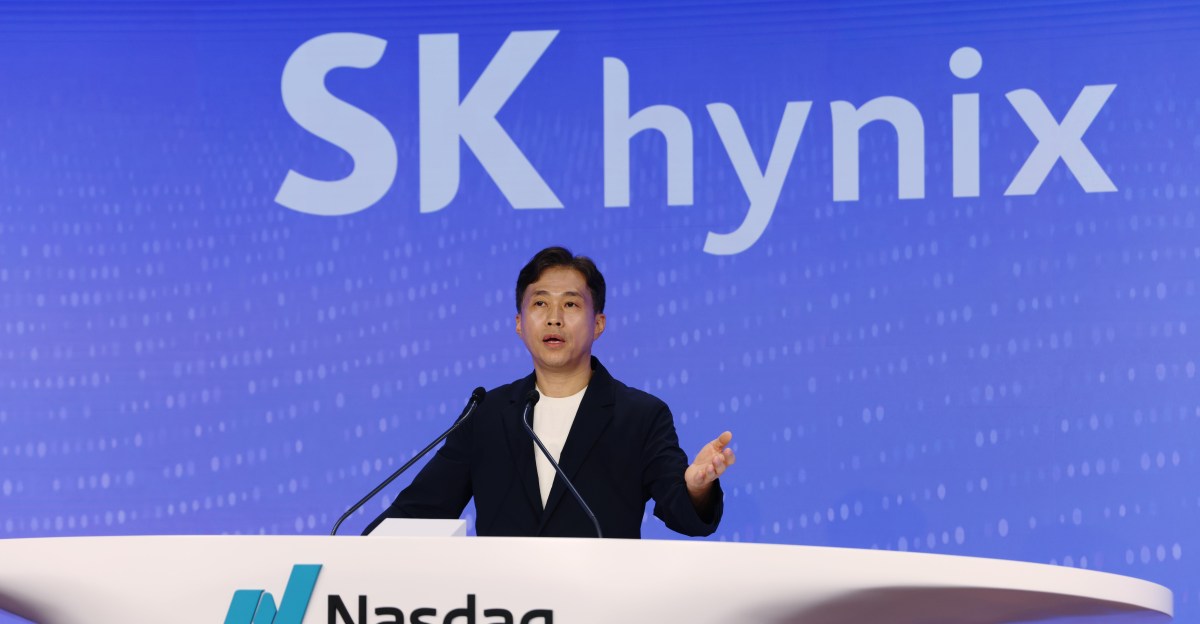
SK Hynix began trading on Wall Street on Friday, opening at $170 a share and raising $26.5 billion, according to reports from the Associated Press and CNN. The debut makes the South Korean chipmaker the largest foreign-company listing on record, ahead of Alibaba’s earlier mark, the reports said.
The listing lands during a memory shortage that has turned boring old RAM into strategic infrastructure. SK Hynix is one of the three dominant suppliers of DRAM and high-bandwidth memory, the parts now being soaked up by AI server buildouts. Nvidia’s Blackwell Ultra and other high-end AI chips rely on HBM packaged with the processor, while data-center servers also need large amounts of DRAM to run AI models.
That demand has pushed SK Hynix into a different class of company. CNBC reported that SK Hynix reached a $1 trillion valuation in May. Fortune reported that the company briefly passed Samsung to become South Korea’s most valuable company in June.
AI buyers are cutting the line
Counterpoint Research data for June 2026 put Samsung at 38 percent of the global DRAM market, SK Hynix at 29 percent, and Micron at 22 percent. Together, those three companies control most of the market. They still have not supplied enough memory to satisfy demand, according to the reporting cited above.
The squeeze is not mysterious. OpenAI, Microsoft, Google, and other large AI customers need memory for servers and accelerators. Those orders compete with the chips used in phones, PCs, game consoles, and other consumer hardware. The result is a market where device makers are fighting for parts while memory vendors prioritize the customers paying the most for AI infrastructure.
DRAM acts as the fast working memory inside servers and client devices. HBM serves a narrower, more expensive role: feeding AI accelerators enough data to keep them busy. That difference matters because the AI boom has shifted production incentives toward the premium memory attached to high-end chips, rather than the commodity modules buyers expect to find in laptops and desktops without a pricing lecture.
SK Group chairman Chey Tae-won said in June that the company plans to increase memory-chip capacity over the next five years, Bloomberg reported. Chey said the effort is meant to address a shortage that could last until 2030, according to Bloomberg.
For investors, SK Hynix’s debut is a bet that the AI memory binge has legs. For everyone buying hardware, it is another sign that the RAM shortage is being priced in at the top of the supply chain before it shows up on a spec sheet.
This story draws on original reporting from The Verge.


