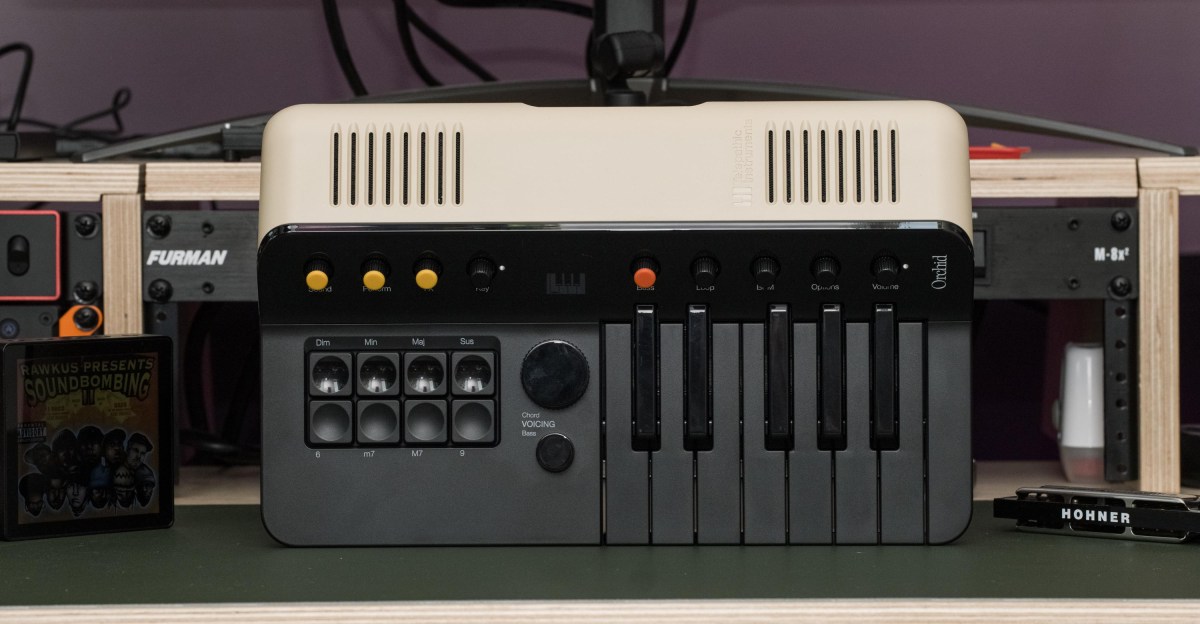
Telepathic Instruments’ Orchid is a $649 digital synth built around an old domestic-music trick: press one button, get a full chord. In a review for The Verge, Terrence O’Brien describes it as a modern descendant of electric chord organs, the mid-century living-room instruments that let casual players accompany songs without learning piano voicings or much theory.
The instrument was designed with Kevin Parker of Tame Impala, according to The Verge. Its visual brief is obvious enough: brown-and-tan retro styling, a speaker grille that nods to the vents on old reed organs, and a general refusal to look like another black plastic MIDI rectangle. The nostalgia is deliberate. The price is less nostalgic.
Old chord organs, including brands such as Magnus and Bontempi, used reeds and airflow, which meant their preset chord options were constrained by physical parts. O’Brien notes that Orchid is digital, so it can generate a much wider set of chords, voicings, and scales than those machines could manage. That is the point of the device: it gives songwriters a fast way to find harmonic movement without turning the session into a theory exam.
How the chord engine works
Orchid has a one-octave keyboard and chord-type buttons beside it. Press a root note and a chord quality, and the box produces the corresponding chord. O’Brien gives examples including C major and F sharp 9. The synth can also lock playback to a key, so a user can keep chord choices inside E minor, B flat major, or another selected scale.
The Verge review says Orchid goes beyond block chords with strum, harp, and arpeggiator modes, plus 13 preset performance patterns. One mode, called “slop,” adds small random timing offsets so the notes do not land with the dead-eyed precision of a quantized machine.
Under the hood, The Verge says Orchid includes three basic synth engines: virtual analog, FM, and reed piano. That gives it access to pads, bell-like and electric-piano sounds, Wurlitzer-style tones, and softer Rhodes-like patches. It also works as a MIDI controller for users who want its chord system driving other hardware or software.
The compromises are baked in
O’Brien’s review is positive, with The Verge assigning Orchid an 8 out of 10, but the limitations are not subtle. The keyboard can play only one key at a time, so users cannot perform their own multi-note piano chords on it. The chord voicings come from the left-side buttons, which makes the machine approachable and restrictive at the same time.
Sound editing is another catch. The Verge says Orchid includes 70 presets, excluding bass sounds, and allows limited on-device changes such as filter cutoff and effects intensity. Users who want to build custom patches need Telepathic Instruments’ Pistil software, which costs $99 separately or $50 when bundled with Orchid. O’Brien reports that Pistil was buggy in his testing and that its interface sometimes froze after patch transfers.
The bass section is separate from the main synth and includes 12 sounds, according to The Verge, ranging from low electric-piano octaves to Moog-style basses, tuned 808s, and more aggressive electronic tones. Orchid also includes an audio looper and a drum machine inspired by 1970s rhythm boxes such as the Korg Mini Pops. The review says the drum machine cannot load custom beats or edit its sounds.
The resulting instrument sits in an odd, useful lane. The Verge argues that buyers looking for deep synthesis should look at more flexible instruments in the same price range, including machines such as Korg’s Minilogue or Arturia’s MiniFreak. Orchid is pitched, and reviewed, as a songwriting helper: a fast chord box for singers and producers who want electronic accompaniment without spending the afternoon wrestling with patch design. That is a narrower promise than “synth,” and probably a more honest one.
This story draws on original reporting from The Verge.


