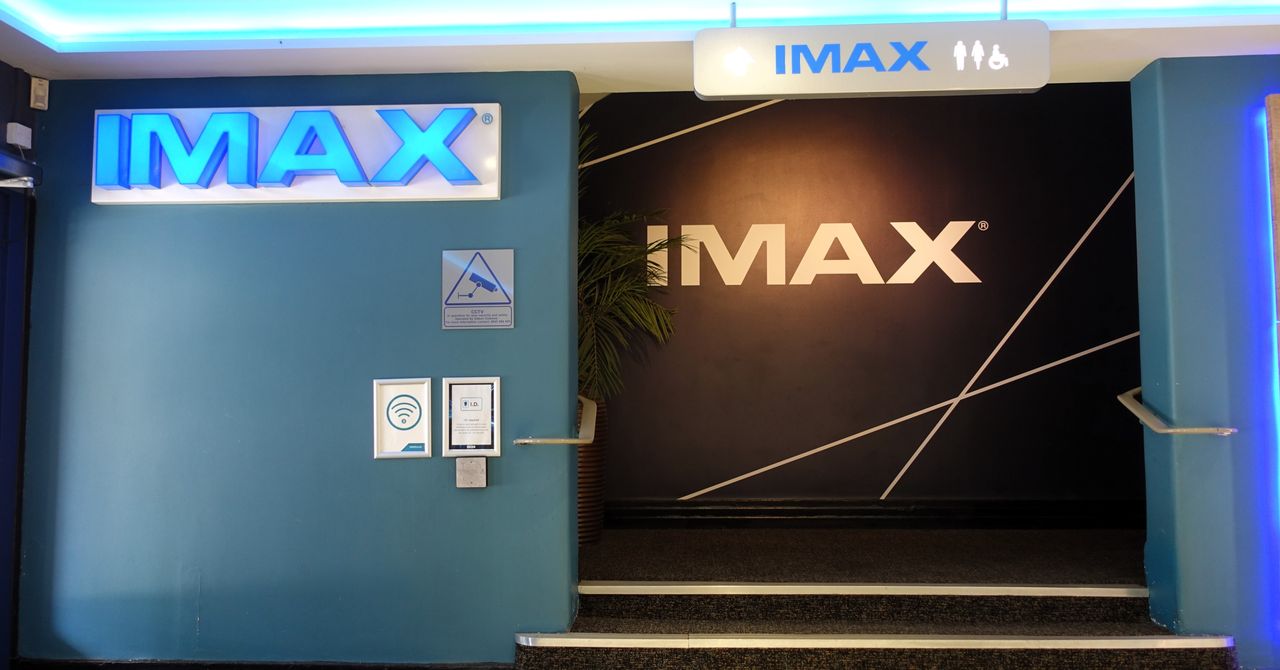
Christopher Nolan’s The Odyssey is in wide release, but The Odyssey Imax 70mm version is available at only 41 theaters worldwide, including 25 in the United States, according to WIRED. Many of those screenings are booked out for weeks, which has turned a technical format choice into a ticketing mess for the viewers most likely to care about it.
The constraint matters because Nolan’s adaptation of Homer is the first feature film shot entirely on Imax film using Imax cameras, according to WIRED. That does not mean every Imax-branded screening shows the same image. It means the top-end version needs a rare 15/70-mm film projector and a large enough Imax screen to use the format’s full 1.43:1 frame.
Where can you see The Odyssey in Imax 70mm?
WIRED reports that only 41 theaters worldwide, 25 of them in the US, can show The Odyssey in full Imax 70mm. The film is playing on thousands of screens overall, but most of those screenings use other formats, including digital Imax, 35-mm, standard 70-mm, and other premium large-format systems.
The reason is mechanical, not mystical. Imax 70mm uses a 65-mm film negative that runs sideways through the camera, creating an image 15 perforations wide. Standard 70-mm presentation is five perforations wide. Projected properly on a giant Imax screen, the 15/70-mm frame is taller, larger, and sharper than the usual multiplex image.
Imax branding now covers several systems. There are digital 2K and 4K versions, xenon and laser light sources, and the older 15/70-mm film setup. Many digital Imax rooms show a wider 1.90:1 image on screens that are smaller than the traditional giant-theater design, according to James Hyder, the former manager of the Smithsonian Air and Space Museum’s Langley Imax theater and former publisher of LF Examiner. Imax did not respond to WIRED’s request for comment.
Why are Imax 70mm theaters so rare?
Hyder traces the split to Imax’s 2008 move into digital projection. The company wanted to expand beyond museums and science centers into regular theater chains, where buildings often could not support the old giant-screen footprint. That helped put Imax logos in more places, but it also made the label less specific.
The film’s own release plan shows the confusion. The Odyssey is being offered in six premium formats, and the movie’s official site includes a format guide explaining aspect ratios and strengths. WIRED notes that the guide separates Imax 70mm from regular Imax, but does not fully spell out how much regular Imax rooms can differ from one another.
Rich Gelfond, Imax’s chief executive, told Variety that the company has not made new Imax film projectors in about 50 years, and instead rebuilds and retrofits existing machines. Variety also reported, citing company sources, that many specialized parts for new film projectors no longer exist. WIRED notes that Imax was still building some new projectors in the late 1990s and early 2000s, but Hyder agreed that building more today would be costly and unlikely.
Digital projection can cover some of the gap. Some older giant Imax screens use 4K laser systems capable of the 1.43:1 frame, though Hyder told WIRED that they do not match the sharpness of 15/70-mm film. He said a more convincing digital replacement might require 8K projection, potentially by stitching multiple 4K projectors across one screen, a technique used in planetariums.
Nolan’s film was composed to survive all of this. WIRED reports that although The Odyssey was shot for 1.43:1, its images were planned to work when cropped to other ratios, including 2.39:1, and across digital, 35-mm, and five-perf 70-mm releases overseen by the director. The full Imax 70mm version remains the rarest cut of the experience, partly because the machines are rare and partly because scarcity keeps the format’s cult status warm.
This story draws on original reporting from WIRED.