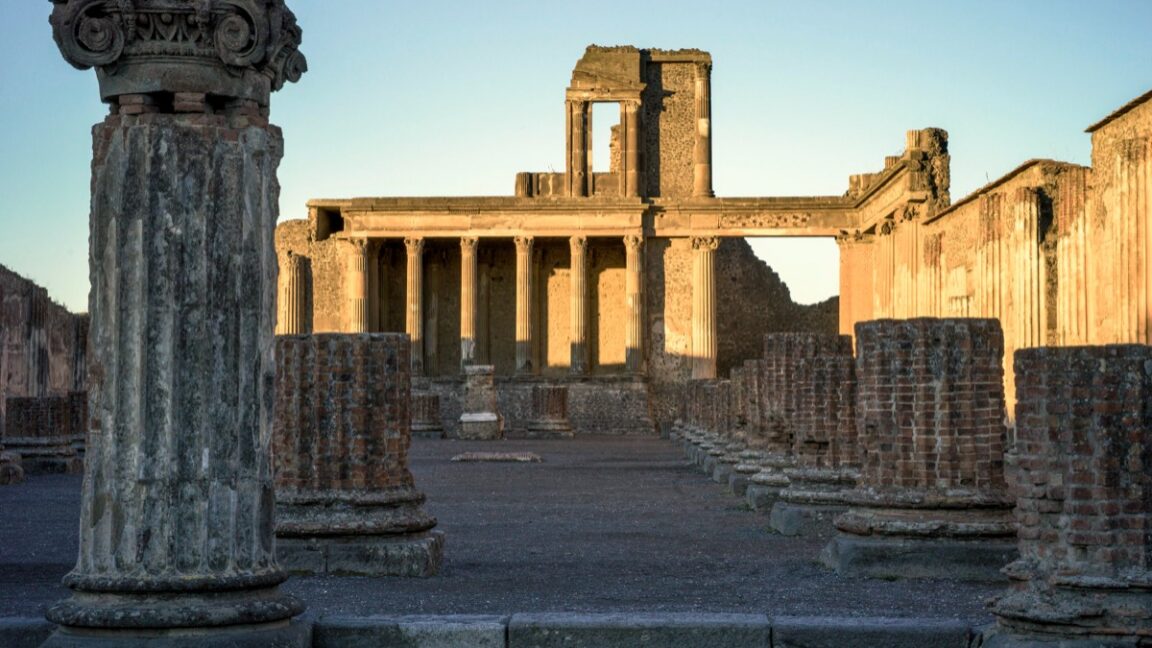
National Geographic is putting Tom Hiddleston in the ruins of Pompeii for a three-part series that treats the city’s final day as both an archaeological case file and a human disaster, not just a backdrop for another volcano explainer.
Pompeii: Out of Time premieres July 21 on National Geographic and arrives the next day on Disney+ and Hulu. The series follows Hiddleston as he investigates three people connected to the eruption of Mount Vesuvius in 79 CE: a teenage boy, a local businesswoman, and a Praetorian guard. The production uses expert commentary, archaeological evidence, scripted dramatic scenes, CGI, and practical effects to reconstruct what may have happened to them during the last 24 hours of Pompeii and nearby Herculaneum.
The Hiddleston casting is not random celebrity garnish, according to executive producer Kevin Wright. Wright previously worked on Disney+’s Loki, which included a time-travel stop in Pompeii. He told Ars Technica that Hiddleston’s interest in the ancient world helped shape the project. Hiddleston studied classics at Cambridge University and visited Pompeii as a teenager, an experience he has linked to his later interest in acting.
Wright told Ars that the team wanted Hiddleston’s enthusiasm to pull in viewers who might otherwise skip a documentary about ancient history. That is the marketing logic, yes, but the format also changes the usual rhythm of this kind of show. Instead of using dramatized inserts as visual wallpaper after an expert has already explained the point, the series gives actors full scenes meant to show the subjects’ emotional lives.
The eruption was not a lava story
The series also brings in geologist and science communicator Chris Jackson to deal with the part of Pompeii history that popular retellings often mangle. Jackson told Ars that many people assume lava killed Pompeii’s residents, partly because black volcanic rock is common in buildings around Naples. He said the destruction in 79 CE came from pyroclastic flows: fast, hot avalanches of ash, gas, and volcanic debris.
Jackson estimated, based on reconstructions, that those flows moved at roughly 100 to 200 kilometers per hour, or about 60 to 120 mph. From a distance they might not have looked fast to people without a modern understanding of scale and speed, he said. Up close, outrunning them was not a plan. It was a physics problem with a grim answer.
Jackson also said Vesuvius reshaped the Bay of Naples. Pompeii and Herculaneum were closer to the sea in 79 CE than they are now, and the flows added land beyond the settlements and altered the shoreline. The eruption also caused a small tsunami, according to Jackson. He added that another volcano northwest of Vesuvius, Campi Flegrei, is believed to have helped form the bay’s distinctive shape through an earlier eruption.
A docudrama with archaeological guardrails
Wright told Ars that showrunner Tom Barbor-Might helped the production get a large-scale look without a Marvel-size crew. The team used visual effects where needed, including large volcanic shots, but also relied on practical methods. For the falling ash scenes, Wright said an Italian special effects team used safe materials, including newspaper, to create the look on set.
The cast includes Lubna Azabal as Julia Felix, a Pompeii businesswoman, and Frankie Treadaway as Avianius. Barry Aird plays the Praetorian guard. National Geographic’s production materials also show archaeological evidence tied to the stories, including records concerning Julia Felix and a sword and belt excavated on the beach at Herculaneum.
The series holds back Pompeii’s famous plaster casts until the end. Wright told Ars that the decision was deliberate because the casts can be treated as tourist objects rather than remains of people who died. The show’s approach, as Wright described it, is to use evidence where it exists and imagination where the record leaves gaps, while being clear that the reconstructed stories are plausible rather than proven.
This story draws on original reporting from Ars Technica.