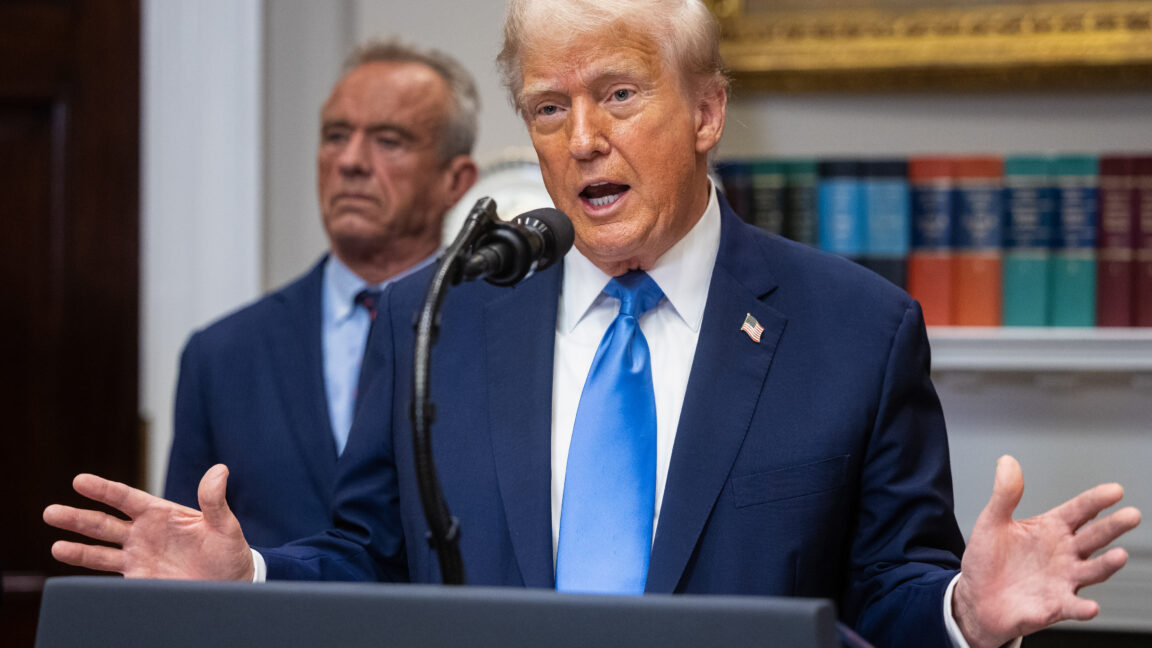
President Donald Trump’s split MMR vaccine order calls for the combined measles, mumps and rubella immunization to be administered as three separate shots. The proposal would turn the current two-dose MMR course into six injections, while the individual products requested are not available in the United States.
The order is guidance rather than a federal mandate, according to the BBC. States set vaccine requirements for school attendance, so it does not by itself require parents or states to use separate shots.
Merck and GSK, the manufacturers of MMR vaccines used in the US, have publicly challenged the premise. Merck said there is no published scientific evidence that separating the vaccine produces a benefit. A GSK spokesperson likewise said separate measles, mumps and rubella shots have not been shown to improve safety or effectiveness over the combined vaccine, according to Ars Technica.
What would it take to split the MMR vaccine?
It would require companies to build products that are not currently on the US market, then put them through development, clinical testing and Food and Drug Administration approval. That is a long regulatory job in service of a policy whose claimed benefit has not been established in the reporting.
Andrew Racine, president of the American Academy of Pediatrics, told CNBC that developing standalone versions would likely take more than a decade. William Moss, a Johns Hopkins pediatrician and epidemiologist, told CNBC he did not expect vaccine makers to spend the time and resources needed for trials and approval of three monovalent vaccines. That is an expert assessment, not an announced refusal by either company.
The arithmetic is also awkward. The CDC’s reported schedule uses one MMR dose at 12 to 15 months and another at ages 4 to 6 years. Breaking each dose into three components means six injections across those visits or additional appointments.
Neil Maniar, a Northeastern University public-health professor, told CNBC that additional appointments create practical barriers for parents, particularly where taking time off work or reaching a provider is difficult. More visits can mean delayed or missed vaccinations, and longer spacing can leave children unprotected against a disease while they wait for a later dose.
Is there evidence that separate MMR shots are safer?
The supplied reporting does not identify evidence supporting that conclusion. Trump linked the combined vaccine to autism and questioned its safety, but multiple studies have found no connection between MMR vaccination and autism, the BBC reported. It cited a 2019 Danish study of 657,461 children that found its data did not support MMR causing or triggering autism.
The BBC also reported that the CDC says there is no published evidence of a benefit from splitting MMR into individual injections and that vaccination is safer than contracting measles, mumps or rubella. Merck has said evidence suggests combination vaccines improve completion of recommended doses and compliance rates, CNBC reported.
PhRMA, the drug-industry trade group, said vaccine-policy changes should meet the evidence standard used for earlier federal recommendations. The immediate dispute, then, is not just over a schedule on paper. It is over whether federal guidance can demand a product pipeline, a clinical evidence base and a delivery system that do not currently exist.
This story draws on original reporting from Ars Technica.


