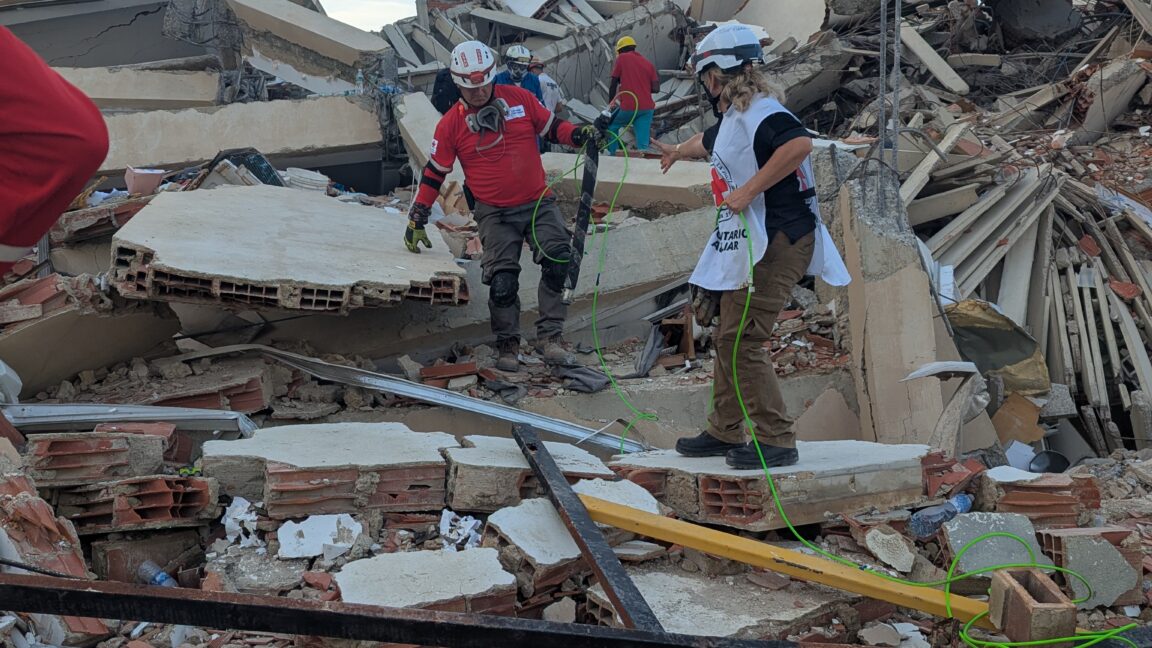
Venezuela earthquake snake robots from Carnegie Mellon University were deployed after two June 24 quakes killed more than 5,000 people and injured 16,740, according to figures cited by France 24. The point was narrow and grimly practical: get a camera into voids where rescuers, dogs and heavier machines could not safely go.
Howie Choset, who leads Carnegie Mellon’s Biorobotics Lab, told Ars Technica that the robots let search teams extend their visual reach inside tightly packed debris. He compared the job to minimally invasive surgery on a damaged structure, which is a useful way to think about the machines: small, controlled, and meant to disturb as little as possible.
How did snake robots search Venezuela earthquake rubble?
Each robot is about four feet long and built from replaceable modules. A human operator steers it with a game controller and a laptop-based control case connected by a tether, while onboard software coordinates the body segments so the machine can crawl, bend and push forward without the operator manually controlling every joint.
The robots carried cameras into collapsed-building debris. That gave rescue workers a view past the first visible opening, which matters in rubble where a survivable void may be several meters in and blocked from direct inspection. The machines were used alongside the less novel tools of disaster work: dogs, listening devices, pole cameras and thermal imaging equipment.
Choset’s group has worked on snake robots for nearly 20 years, including versions intended for archaeological exploration, underwater movement and surgical assistance. Carnegie Mellon previously tested the robots in a real disaster response after the 2017 Mexico City earthquake, when the team helped inspect a collapsed apartment building.
The Venezuela deployment began in an odd way. Beatriz Gonzalez, a Venezuelan living in Atlanta, asked Grok for ways to support rescue work after the quakes, The Tribune-Review reported. The chatbot pointed her to Carnegie Mellon’s earlier Mexico City work, and Gonzalez contacted Choset’s lab.
The researchers agreed to go while preparing a robot demonstration at a June 27 concert in Pittsburgh’s Point State Park, Choset told Ars Technica. They packed overnight, repaired or replaced several head cameras, gathered extra batteries for the control case and flew toward Miami within 24 hours with three robots. Gonzalez then helped the team find private air transport into Venezuela after some jet owners withdrew over Venezuelan government restrictions, according to Ars Technica.
After arriving in Venezuela on June 30, the Carnegie Mellon team was met by US Marines and then transferred to the Venezuelan Red Cross, which took them to La Guaira, a heavily damaged city on the northern coast. The researchers worked with international rescue teams at several collapsed-building sites from June 30 to July 3.
At one apartment building, Choset’s team sent a robot into a small opening after a Jordanian dog team found no sign of survivors and a Colombian team’s infrared equipment suggested someone might still be inside. A Venezuelan father waited nearby for news about his missing young son. The robot traveled about 15 to 20 feet into the rubble and found no one, Ars Technica reported.
The Carnegie Mellon team returned to the United States without finding a survivor. Choset said Venezuelans continued feeding and helping the researchers despite their own losses. Separately, international search-and-rescue teams helped save nearly 6,500 people after the quakes.
The wider damage remains severe. The United Nations has requested nearly $300 million to assist more than 1.3 million affected people, and the World Bank estimated building damage at $19.6 billion. The Financial Times has reported that the Trump administration collected more than $13 billion in revenue from Venezuelan oil exports and sales after seizing control of those funds, and that lawmakers have pressed for clarity on how the money is being handled.
Choset’s lab is treating the mission as a field test, not a victory lap. The robots remain research prototypes rather than standard rescue gear. The team wants to add light-based sensors for 3D point-cloud mapping, which could give operators and rescuers a clearer model of the voids the robot is entering. Choset also said the group is documenting basic logistics, including what to pack and how to pack it, because in disaster robotics the boring checklist can be the difference between a useful tool and an expensive cable snake.
This story draws on original reporting from Ars Technica.