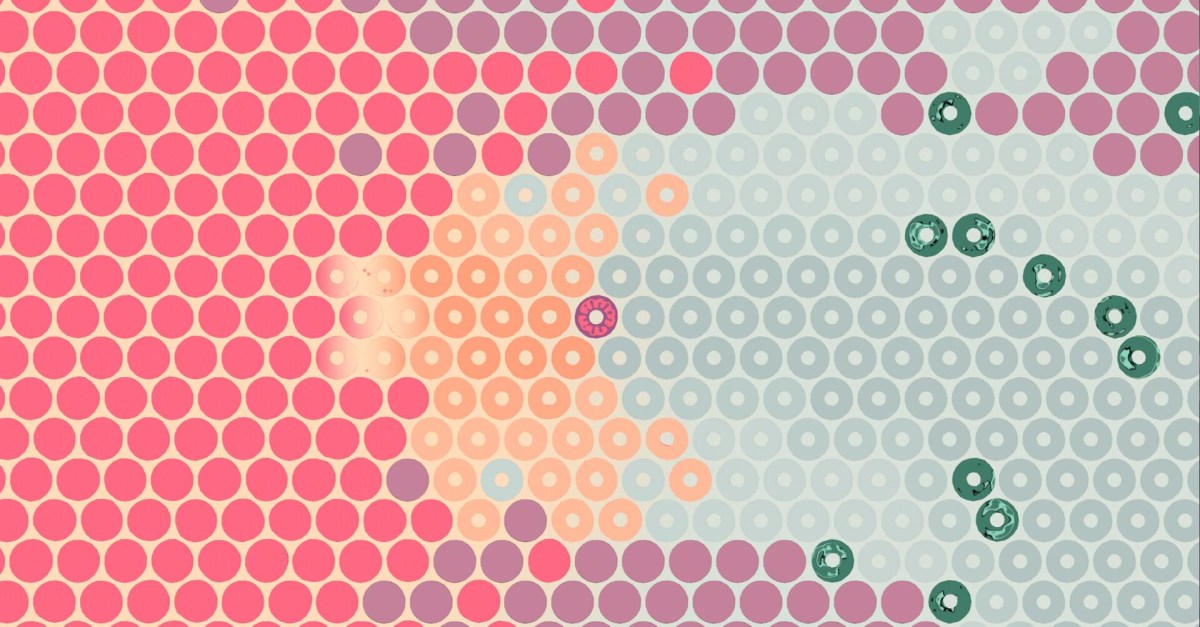
A new What Surrounds Us review from The Verge describes the indie game as an exploration puzzle game built almost obsessively around circles, from its player character to its world map. Jay Peters writes that the shape is more than visual shtick: it reinforces the game’s ideas about connection, surroundings and the environment.
The player controls a ring-shaped character with an empty center, which Peters compares visually to a frosted donut. Other moving, apparently conscious circles populate the world, and the player sometimes helps them connect with one another. The map itself is also made from linked circular spaces, so the game does commit to the bit with unusual discipline.
That design could have collapsed into gimmickry. According to Peters, it instead sits on a familiar adventure-game frame. He says the structure brought to mind The Legend of Zelda, with a trip across three separate regions, lightweight environmental puzzles and new traversal abilities that gradually open more of the world.
What is What Surrounds Us?
What Surrounds Us is an indie exploration game where the player moves through a circular world as a circular character, solving small puzzles and gaining abilities to reach new areas. The Verge’s review presents it as a sparse, word-light adventure that expects players to learn by trying things rather than reading instructions.
The mechanics Peters describes are modest but purposeful. One ability lets the player charge up a large jump to cross gaps. Later, the route is complicated by a glitch-like substance that winds through the world and cuts off access. That is standard adventure-game gating, dressed in the game’s weirder visual language.
The review also notes that What Surrounds Us gives players very little explicit direction. Peters says the game contains almost no text and only a small number of prompts for controls. As a result, progress depends on roaming, testing the available tools and noticing how the world reacts.
One example from the review: using a ping near a dark circle can reveal a way forward. That kind of discovery is the game’s bet. It asks the player to poke at its systems without a tutorial grabbing the steering wheel every thirty seconds, a design choice that can feel elegant or maddening depending on how much patience the player brings.
How does the game use circles?
The review says circles are everywhere in What Surrounds Us: the avatar, the other beings, and the spaces that make up the map. Peters argues that repetition supports the theme rather than serving only as decoration, because the game keeps returning to relationships among the player, the environment and nearby creatures.
That makes the game’s title unusually literal. The central idea is not just that the player is surrounded by a world, but that movement, progress and problem-solving depend on paying attention to what is nearby. For a game with little text, that is doing a lot of communication through layout and interaction.
The Verge published the review on July 25, 2026, as part of its ongoing indie game recommendations coverage. Based on Peters’ account, What Surrounds Us is a small, strange adventure whose clearest pitch is also its design document: circles, systems and just enough Zelda-like structure to keep the weirdness from floating away.
This story draws on original reporting from The Verge.