As the Eaton and Palisades fires tore through Los Angeles County in January 2025, traders on Polymarket were wagering on how far the fires would spread, when they would be contained, and how much they would destroy.
The fires killed 31 people and destroyed more than 16,000 structures, according to figures cited by PBS. For survivors, the arrival of disaster betting was not an abstract market-design debate. Sylvie Andrews, who lost the Altadena home she and her partner had helped build, told High Country News that learning people had wagered on the fires was “morally reprehensible.” Susan Sherman, whose family home in Pacific Palisades burned, called the practice “crass and heartless.”
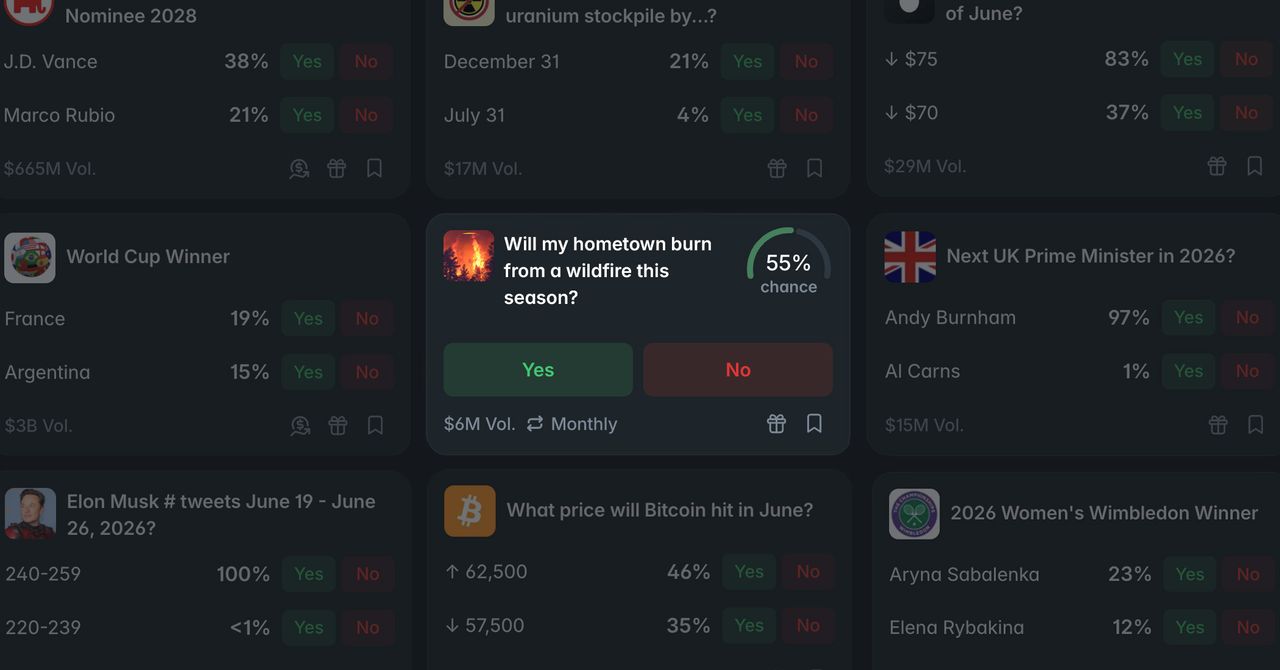
Prediction markets let users buy contracts tied to future events. A market usually asks a yes-or-no question, and contract prices move between $0 and $1 as traders buy and sell. A 50-cent “yes” price is commonly read as the market assigning roughly even odds. Platforms make money by charging fees on trades. The pitch is that crowds can surface useful probabilities. The less polished version is that people are gambling on whatever a platform decides to list.
Polymarket, the largest prediction market platform, listed almost 20 wildfire-related markets in January 2025, according to High Country News. The questions covered outcomes such as the acreage burned by the Palisades Fire by a certain date, whether it would reach Santa Monica, when it would hit 50 percent containment, and whether the Palisades and Eaton fires would be fully contained before February. Aeon Magazine reported that users put $1.2 million into those markets.
Fire agencies reject the data pitch
Wildfire contracts raise a specific problem that election or weather markets do not: a person can start or worsen a fire. The US Forest Service told High Country News that systems linking profit to wildfire outcomes risk misuse, including arson, and do not fit the agency’s mission.
Ann Skeet, senior director of leadership ethics at the Markkula Center for Applied Ethics at Santa Clara University, told High Country News that a market capable of rewarding harmful conduct is dangerous. She also warned that firefighters or land managers with nonpublic information about fire behavior or suppression plans could be tempted to trade on it, a form of insider dealing.
Federal and state fire officials also rejected the idea that betting markets add useful forecasting signal. The Forest Service said it does not use prediction-market information and relies on validated science, federal data, and tools from partners including the National Weather Service, NOAA, and the National Interagency Fire Center.
California’s Department of Forestry and Fire Protection gave a similar answer. Phillip SeLegue, staff chief of Cal Fire’s intelligence program, told High Country News the agency does not use or evaluate prediction-market data for forecasting or operations. Cal Fire’s system generates fire-spread predictions when a wildfire 911 call is processed, using weather, fuels, vegetation, topography, location, and resource data. SeLegue described the model as deterministic and physics-based, rather than driven by wagers or crowd predictions.
A dedicated wildfire market appears
A new site called Wyldfyre has appeared ahead of another Western fire season, presenting itself as a California wildfire prediction market. Its tagline says users cannot predict wildfire, but can trade on it. High Country News reported that it could not identify the platform’s owner or the owner of the website’s IP address, and that the site lists no contact information.
Wyldfyre currently offers simulated trading, while saying real-money betting is “coming soon.” The site says it prices city and county wildfire risk in real time and uses NASA hotspot data and National Interagency Fire Center perimeter data.
Lawmakers have started drawing boundaries around prediction markets, though wildfire contracts are not named in the proposals cited by High Country News. Representatives from Utah and California introduced federal legislation in March that would bar betting tied to terrorism, assassination, war, gaming, or illegal activity, according to a press release. A companion bill from a California senator would also ban contracts tied to an individual’s death. Minnesota has enacted a state ban on hosting or advertising prediction markets, and the federal government has sued the state over it.
For Andrews, the cleaner remedy is not technical. She told High Country News that anyone who profited from wagers on fire victims’ fate should donate the winnings to survivors.
This story draws on original reporting from WIRED.