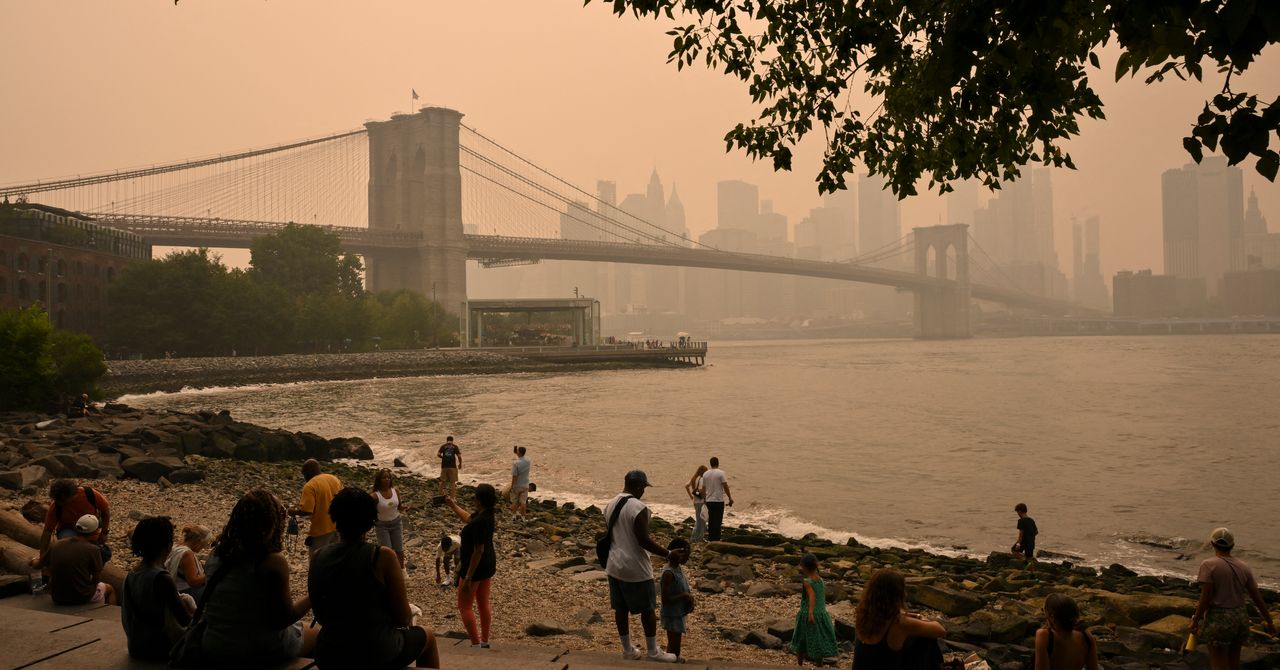
Smoke from wildfires in Minnesota and western Ontario spread across the Midwest, Northeast and parts of Canada this week, turning city skylines orange and forcing air-quality alerts in places that were nowhere near the flames, WIRED reported.
By Friday, Chicago and Detroit had the worst air quality in the world, according to WIRED. New York and Washington, DC, also reached the global top 10 for polluted air. That is the part of wildfire risk that does not care about state lines, lakefront property, or whether a city thinks of itself as a fire zone.
Canada was carrying most of the fire load. WIRED reported that 119 Canadian wildfires were classified as out of control as of Friday afternoon. Fires burning at high intensity can loft smoke high into the atmosphere, where winds in the jet stream can move it long distances. In this case, that conveyor belt pushed smoke eastward into major population centers.
Officials in affected cities told residents to remain indoors because wildfire smoke can be harmful to breathe, WIRED reported. Some places were expected to get cleaner air over the weekend, but the fires themselves had not let up, raising the possibility of more smoke later in the summer.
What the smoke looked like
Getty Images photographs cited by WIRED showed smoke-darkened or orange-tinted scenes in Toronto, New York, Jersey City, Detroit, Washington, DC, Minneapolis, St. Paul, Philadelphia and Chicago. The images included reduced visibility over skylines, haze around landmarks and people outside in visibly smoky conditions.
Washington, DC, photos by Finn Gomez and Kevin Carter for Getty Images showed smoke over the capital skyline and the sun rising behind the US Capitol during a summer heat wave, according to the image captions cited by WIRED.
Chicago, Detroit and Minneapolis were among the cities closest to the fire-driven plume, but the impact reached far beyond the upper Midwest. New York, Jersey City, Philadelphia and Washington, DC, all saw the same basic physics: fine particles from combustion riding atmospheric currents into lungs hundreds of miles from where trees were burning.
Climate signal, public-health cost
WIRED reported that the episode echoed 2023, when Canada's record wildfire season sent smoke into the eastern United States. Similar orange-sky events have also occurred in recent years in Australia, California and Europe, including Spain this summer, as fires burned through different regions.
Research published in Nature last year projected a worsening health toll if coal, oil and gas use is not reduced. The study estimated that wildfire smoke could cause 71,420 excess deaths each year in the United States by mid-century, a 73 percent increase from the 2010s. The researchers also estimated that as many as 1.9 million people in the US could die from smoke-related health problems between now and then.
The immediate forecast may clear the air in some cities. The longer-term problem is harder to ventilate: hotter conditions linked to fossil-fuel warming increase the odds of destructive fires, and destructive fires produce smoke that can turn a distant city's summer afternoon into a public-health warning.
This story draws on original reporting from WIRED.