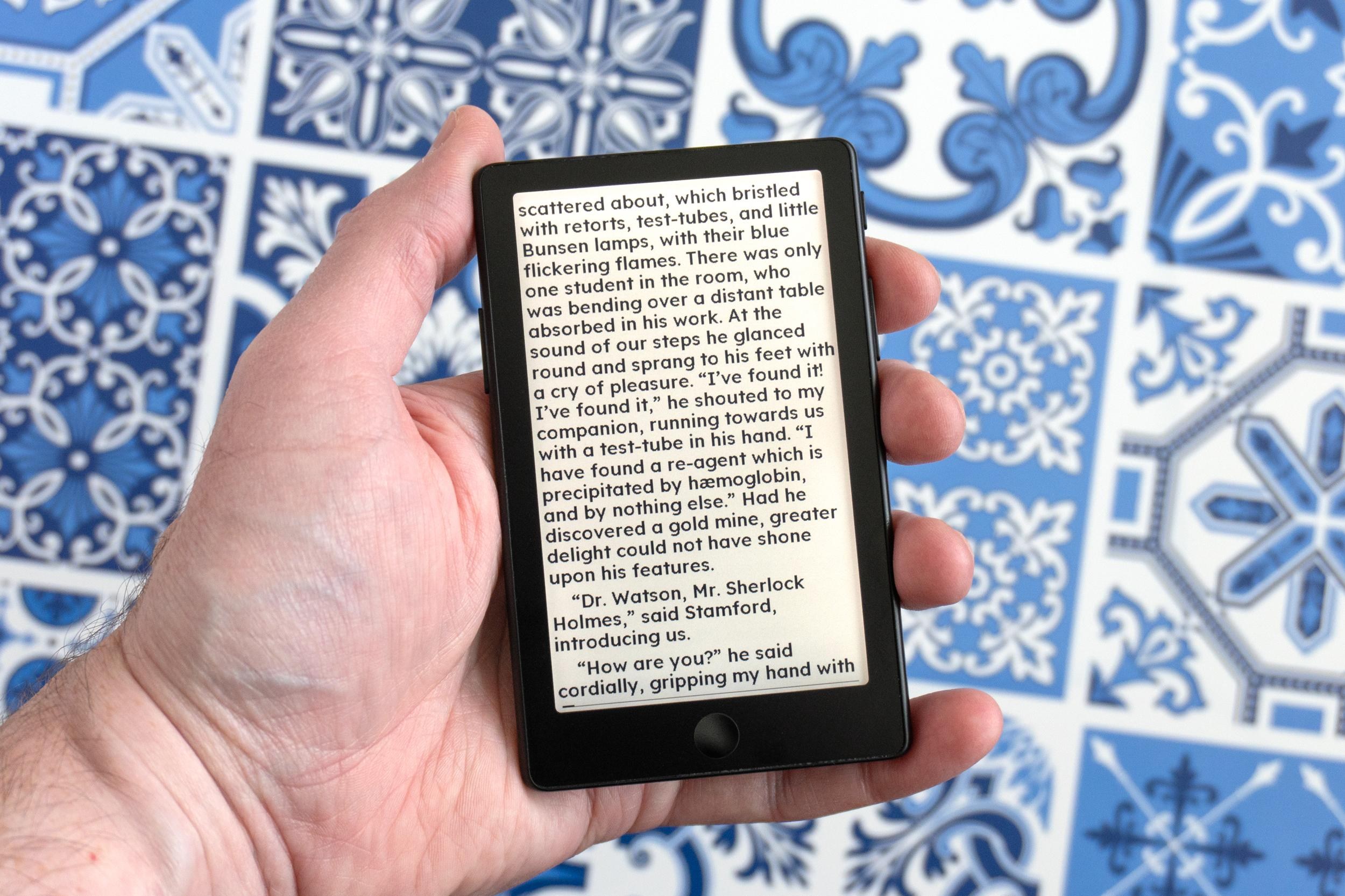
Xteink has started selling the X4 Pro, a $99 miniature E Ink reader that adds a touchscreen and built-in screen lighting to the company’s pocketable hardware. Those two additions matter because Xteink’s earlier tiny readers asked buyers to accept some very 2010 compromises: button-driven menus, no reading light, and software that made loading and reading books feel harder than it should.
According to The Verge’s review, the X4 Pro is the most capable version of Xteink’s small e-reader line so far, even if it still does not match the smoother experience buyers get from Amazon’s Kindle or Kobo devices. The device is available through Xteink’s online store and costs more than Xteink’s $79 X3 and $69 X4. It also sits close to Amazon’s $110 entry-level Kindle, which comes with a more mature interface and direct access to Amazon’s ebook store.
The X4 Pro uses a 4.26-inch E Ink display with an 800 x 480 resolution. The Verge says it is slightly shorter and thinner than Xteink’s original X4 and far smaller than Amazon’s 6-inch Kindle. That size is the pitch: this is an e-reader meant to disappear into a pocket rather than live in a bag.
Xteink paid for that thinness with a nuisance. The X4 Pro drops a standard USB-C port and instead uses a magnetic pogo-pin connector on the back. Xteink includes an adapter that provides USB-C-style connectivity, but The Verge’s reviewer said he would prefer a thicker device with a normal USB-C port. Fair. Dongle life is not a feature.
The back also includes magnets for attaching the reader to compatible phones, similar to a magnetic battery pack. The Verge found the magnets stronger than on earlier Xteink models, but still not secure enough to trust in a pocket. On an iPhone 16 Pro, the reader also hung past the bottom of the phone by about half an inch, making the phone-mounting idea look less useful than Xteink’s marketing suggests.
Touch helps, but the software still drags
The new touchscreen changes the control scheme. Xteink kept physical page-turn buttons on both sides, added a power and wake button, and placed a touch-sensitive home button below the display. The Verge said touch input makes the X4 Pro much easier to handle than earlier Xteink readers, whose button-only controls could feel awkward even after extended use.
The touchscreen is not up to Kindle or Kobo standards, according to the review. Taps sometimes need to be repeated with more pressure before the device registers them. The Verge said that could potentially improve through software updates, though no fix has been confirmed.
The front light is the other major upgrade. It can be adjusted for brightness and color temperature with sliders accessed by swiping down from the top of the screen. The Verge found the light somewhat uneven and brighter near the top, and noted that the X4 Pro currently lacks automatic adjustment and scheduling. Still, having a light makes the device usable in bed without a lamp, which older Xteink models could not do.
Xteink has also revised its built-in interface for touch, with simpler menus, easier access to reading settings, and more controls for text spacing and layout. The Verge says the stock software remains limited, including just one built-in font in two sizes unless users manually add more.
The bigger software development comes from outside Xteink. Justin Mitchell, the core maintainer of CrossPoint Reader, told The Verge that support for the X4 Pro would be ready before U.S. customers could order and receive the device. CrossPoint Reader is a free alternative firmware for Xteink readers, and it is now part of Mitchell’s Free Ink project, which lists Xteink as a hardware partner.
The result, per The Verge’s review, is a tiny e-reader with better hardware than Xteink’s previous models and a plausible escape hatch from Xteink’s rougher software. Buyers still have to accept the proprietary magnetic connector, imperfect touch response, and a less polished ecosystem than Kindle or Kobo. For people who care most about size, the X4 Pro is now the Xteink model to beat.
This story draws on original reporting from The Verge.