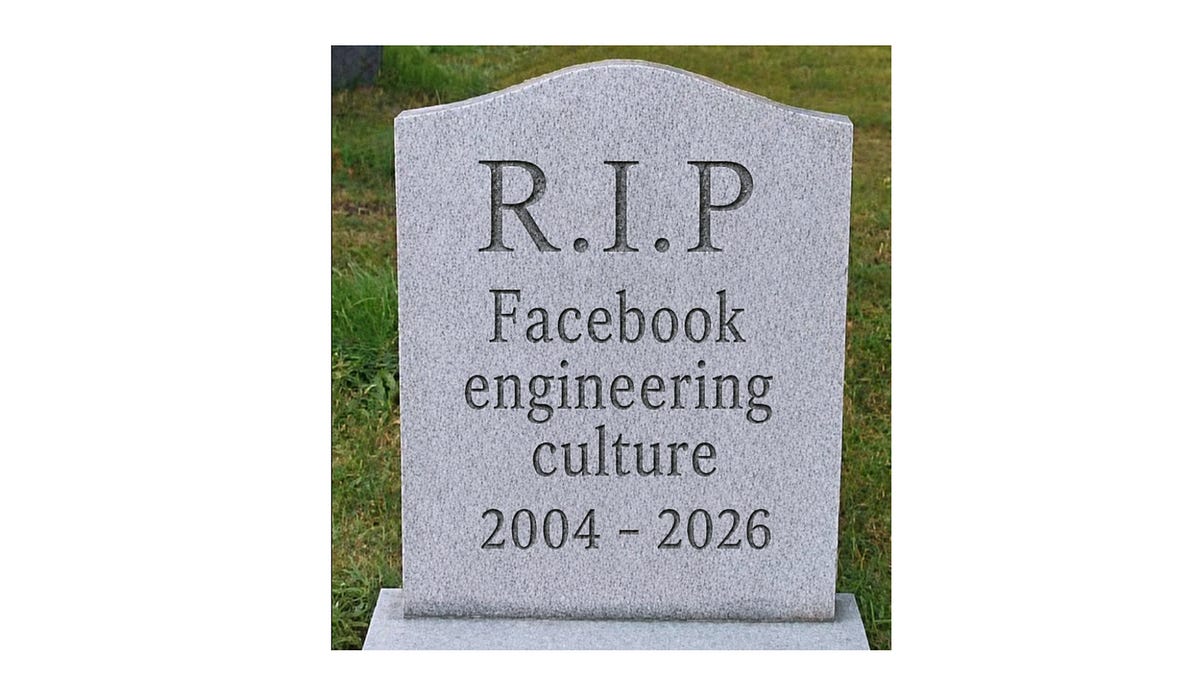
Meta’s latest AI push is landing hardest on its own software engineers: Gergely Orosz of The Pragmatic Engineer reported that the company has moved large numbers of engineers into AI training work, planned employee activity logging for model training, and tied AI token usage to performance reviews.
The shift matters because Meta built much of its engineering reputation on autonomy. According to Orosz, Facebook historically hired many engineers into the company rather than into fixed teams, put new hires through a bootcamp, and let them match with groups based on interest and available headcount. That system had already weakened by 2024, he reported, but the current AI reorganization is a sharper break.
Orosz reported that since late April, product engineering teams have been told to send 30% to 50% of engineers into ADO, Meta’s Agent Data Optimisation organization. He said infrastructure and security teams were hit particularly hard, and that some teams lost their strongest engineers to the reassignment.
The work is not just clicking boxes. Orosz described tasks that include writing prompts for coding agents, creating tests to verify the output, packaging the work in Docker containers using the Harbor framework, reading AI-generated code and providing feedback. That requires real engineering skill, but several Meta engineers told him the work becomes repetitive and has unclear career value.
Orosz estimated that ADO has about 6,500 people, including roughly 4,000 to 5,000 software engineers. Meta has about 25,000 engineers, he reported, which would put roughly one in every five or six engineers into full-time AI training work.
The staffing move follows Meta’s broader attempt to catch up in frontier AI. Orosz noted that Meta released Llama 1 in February 2023, Llama 2 in June 2023, Llama 3 in April 2024 and Llama 4 in April 2025. He reported that Meta later bought a 49% stake in Scale AI for $14.8 billion and brought Scale CEO Alexandr Wang into Meta to run its AI strategy. Scale is known for labeled training data, reinforcement learning from human feedback and fine-tuning pipelines.
Reuters reported in June that Meta was scaling back parts of a plan to collect employee mouse movements, keystrokes and other actions for AI training after staff objections. Reuters said an internal memo by Stephane Kasriel, a vice president in Meta’s Superintelligence Labs unit, introduced controls allowing workers to pause collection for up to 30 minutes and seek exemptions. Orosz reported that current Meta engineers told him the system had not rolled out in the UK because of data protection rules.
The pressure is not only about assignments. Reuters reported in April that Meta planned to cut 10% of staff, with the first wave targeted for May 20. Orosz wrote that engineers then spent weeks knowing layoffs were coming while reassignments to AI labeling were already under way.
Orosz also reported that Meta’s Performance Summary Cycle is unusually combative, with managers arguing over employee rankings and measurable output. He said engineers learned that managers would inspect AI token counts in performance reviews. The Information reported that Meta employees used 60.2 trillion AI tokens over 30 days, which Orosz said would cost $900 million at Anthropic API prices, though Meta likely pays less.
The predictable result, according to Orosz, is metric theater: engineers using AI more because the company measures it, while some longer-tenured employees look for exits. For a company that used to sell engineers on impact and ownership, that is quite the self-own.
This story draws on original reporting from Daring Fireball.