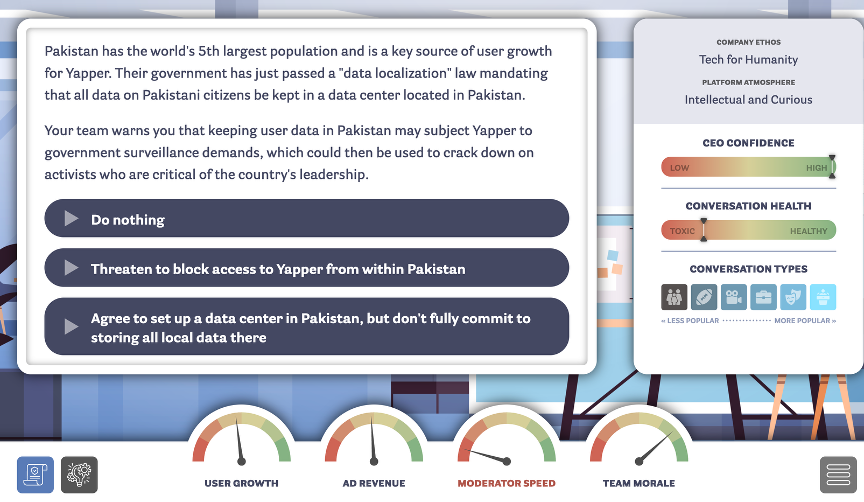
A Trust & Safety Tycoon classroom assignment gives students a controlled run at the decisions behind a fictional social platform’s rules, enforcement and budget choices. The browser game casts each player as the head of trust and safety at Yapper, a rapidly growing social network, where every clean-looking policy choice tends to irritate somebody with money, power or a subpoena.
Techdirt reported that an instructor has used the game in a media law and ethics course since 2023. The exercise comes around the fourth week, after work on media ethics, platform terms and First Amendment issues. That sequencing matters: the game can supply scenarios for applying concepts, but it is not evidence that a student has learned the law.
How can teachers use Trust & Safety Tycoon in class?
The reported format is compact. Explain the assignment in class, then send students to the game and give them 48 hours to finish it. Require two playthroughs: one to learn the system, then another in which students make their considered choices. At the end, students submit a selfie with the final screen through the course-management system. The instructor chose a selfie rather than a screenshot because screenshots can be copied or downloaded.
Time estimates are fuzzy, as game estimates usually are. The instructor said one run takes roughly 20 to 30 minutes and the two-run task can take less than an hour. Leveraged Play’s developer overview lists a 45-to-90-minute duration. Budget about an hour for play, then reserve class time for the part that actually turns clicking into teaching: the debrief.
Players set policies, handle moderation cases and choose investments while trying to keep measures such as moderation speed, user growth, conversation health, advertising revenue and team morale from collapsing. Techdirt says the game works in desktop and mobile browsers; it was released in October 2023 through a collaboration involving Copia Gaming and Randy Lubin at Leveraged Play, with Hewlett Foundation support.
What should students discuss after playing?
Have each student identify one decision, the stakeholders affected, the trade-off they expected and the legal or policy issue they think applies. Then compare decisions across the room. The scenarios described by the instructor include offensive content and boycott threats, government removal demands, law-enforcement requests, copyright and parody disputes, privacy rules, age-verification laws, misinformation and congressional scrutiny.
That produces a useful route into copyright, free speech, defamation and privacy, along with the gap between U.S. and foreign regulatory approaches. It also makes students distinguish government action from a private platform’s own decisions. Community guidelines and acceptable-use policies are conditions users agree to as part of using a service, according to the Digital Trust & Safety Partnership’s glossary, which notes its terms are not legal definitions.
Instructors should flag the material in advance. The game includes terrorism-related videos, an active-shooter incident and law-enforcement demands, according to the classroom account. An alternative activity may be appropriate for students who cannot participate in those scenarios.
A completion-focused grade can keep the task from pretending to measure mastery. The instructor reported a 0-to-2 grading scale, though the available account does not include the full rubric. Leveraged Play says more than 30,000 people have played and reports that more than 65% of respondents to its post-game survey said the work seemed harder than expected. Those are developer-reported, self-selected survey results, not a controlled measure of classroom learning.
This story draws on original reporting from Techdirt.