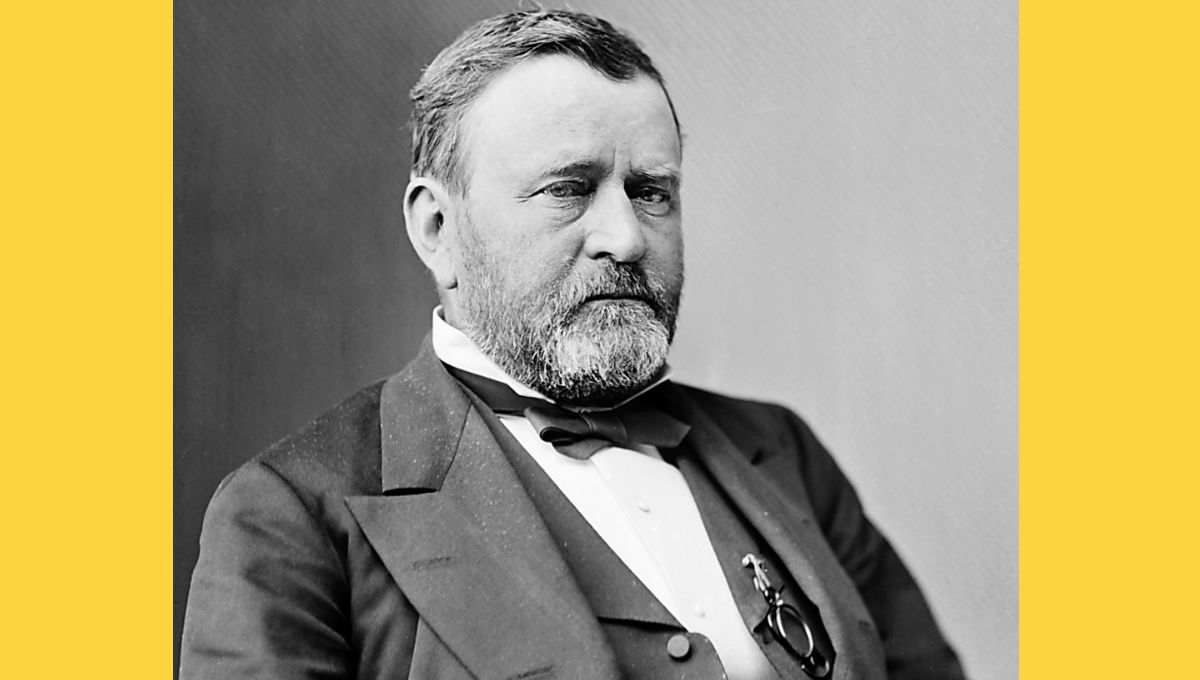
The viral Ulysses S. Grant future dividing line quotation is authentic, but it was not a forecast of any particular modern conflict. Grant delivered the conditional warning on Sept. 29, 1875, at the Army of the Tennessee’s annual reunion in Des Moines, Iowa, according to Snopes, which rated the attribution correct.
Grant told the veterans that, “If we are to have another contest in the near future of our national existence,” its boundary would be “not Mason and Dixon’s,” but a divide between “patriotism and intelligence” and “superstition, ambition, and ignorance.” The sentence now circulates as a tidy prediction of a future civil war. Its surrounding text points somewhere much more specific: public education, religious instruction and the use of public money for schools.
What did Ulysses S. Grant mean by the future dividing line?
Grant argued that citizens were sovereign in a republic and therefore needed education to exercise that power. He called free schools the means of developing the intelligence needed to preserve a free nation, according to the text reproduced by Snopes.
His prescription was blunt. Grant urged governments to ensure that every child could receive a common-school education. He opposed diverting school funds to sectarian schools and said instruction should be free of sectarian, pagan and atheistic tenets. Religion, he said, belonged with families, churches and privately financed schools; church and state should remain separate.
The speech also called for stronger protection of free thought, free speech, free press, religious liberty and equal rights regardless of nationality, color or religion. Those points matter because the clipped quotation commonly omits the argument Grant was actually making before and after it.
A fight over schools and religion in 1875
The National Park Service says the address came amid political fights over public education and religion. It describes the speech as partly responding to an Ohio Democratic measure requiring prisons and state hospitals to provide inmates religious instruction in their own faiths.
That dispute unfolded alongside Protestant anxieties about Catholic immigration, allegations that Catholics owed greater loyalty to the pope than the United States, and opposition to potential public subsidies for Catholic schools, according to NPS. Many Republicans, including Grant, turned those fears into a political issue.
Grant did not say “Catholic” in the speech. Still, NPS says Catholic journals condemned the remarks and charged Grant with anti-Catholicism. That history does not permit the quote to be treated as a generic, context-free statement about civic virtue. It was part of a sharp 19th-century argument over religion, schooling and public power.
Why did the quotation resurface?
Snopes reported that the line spread again on social media after the Jan. 6, 2021 attack on the U.S. Capitol. Its endurance is easy enough to understand: the phrasing is portable and the Mason-Dixon reference supplies instant Civil War imagery. But Grant’s wording was conditional, and the 1875 address did not identify a later event, party or movement.
Readers looking to verify the passage should favor the documented speech and historical accounts over quote-collection pages. Goodreads, for example, says entries on its quotation pages are submitted by its community and are not verified.
This story draws on original reporting from Snopes.