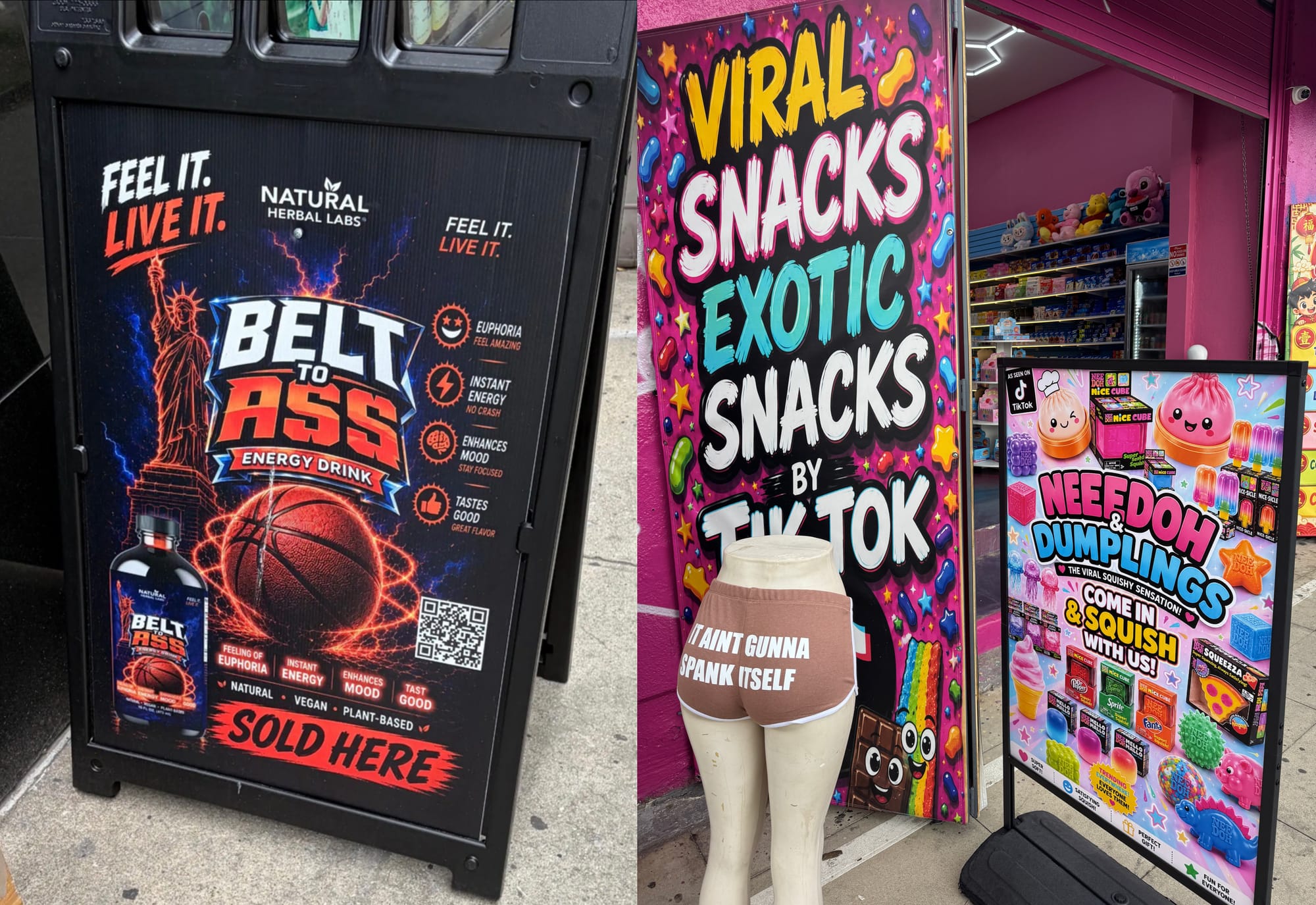
404 Media asked readers for examples of “ChatGPT flyers,” the AI-generated posters and ads now appearing in ordinary public spaces, and received enough submissions to make the point without a benchmark suite or a TED Talk.
The collection, published by 404 Media, shows generative-AI graphics moving well beyond social feeds. Readers sent in examples from bulletin boards, restaurant menus, table cards, business cards, store signs and billboards, according to the outlet. The recurring complaint was not subtle: the material looks cheap, uncanny and, in some cases, wrong in ways a human designer or printer might have caught before taping it to a wall.
404 Media said it prioritized examples that had escaped the screen and appeared in physical spaces, along with submissions that were especially strange. That distinction matters. A bad AI image in a group chat is disposable sludge. A bad AI flyer on a restaurant table, a city notice or a public-event sign is an actual design decision made by a business, agency or organizer.
Where the flyers showed up
One reader told 404 Media they spotted an AI-looking table card at a Mexican restaurant in a rural Ohio hometown while visiting to help care for an aging parent. Another reader in New Haven described becoming an informal spotter of AI signs, while admitting that identifying them can come down to pattern recognition rather than hard proof.
That caveat is useful, and not just lawyer bait. Generative-AI detection in images is messy. The obvious tells are often warped text, fake logos, impossible objects, strange hands, smeared typography and visuals that look polished at thumbnail size but collapse under inspection. 404 Media’s examples include one beer-related flyer where, according to the outlet’s caption, many beer company logos were wrong. That is the machine doing brand cosplay and failing the open-book portion of the test.
The submissions also reached civic and community settings. A reader said their city and parking authority used an AI-generated image to promote a public engagement event for a new mural. The reader noted that the city promotes a growing Arts District and said there was no human communications team.
Another submission came from Altadena, California. The reader told 404 Media that generative-AI flyers became more common in town after the Eaton Fire, and said that 18 months later, two out of three Altadena residents were still displaced. The reader added that recovery conditions made it difficult to criticize organizers using AI graphics for events meant to support a harmed community.
The complaint is about labor and care
Readers’ responses to 404 Media were angry, funny and exhausted. Several said they had begun seeing the flyers everywhere after learning what to look for. One said local groups had only recently started using AI-made flyers but that the practice had accelerated in recent months.
The submissions do not prove that every odd poster is AI-generated. They do show that readers are increasingly reading public design as a signal of effort: who made it, who checked it, and whether anyone cared enough to fix the fake logos before printing.
This story draws on original reporting from 404 Media.