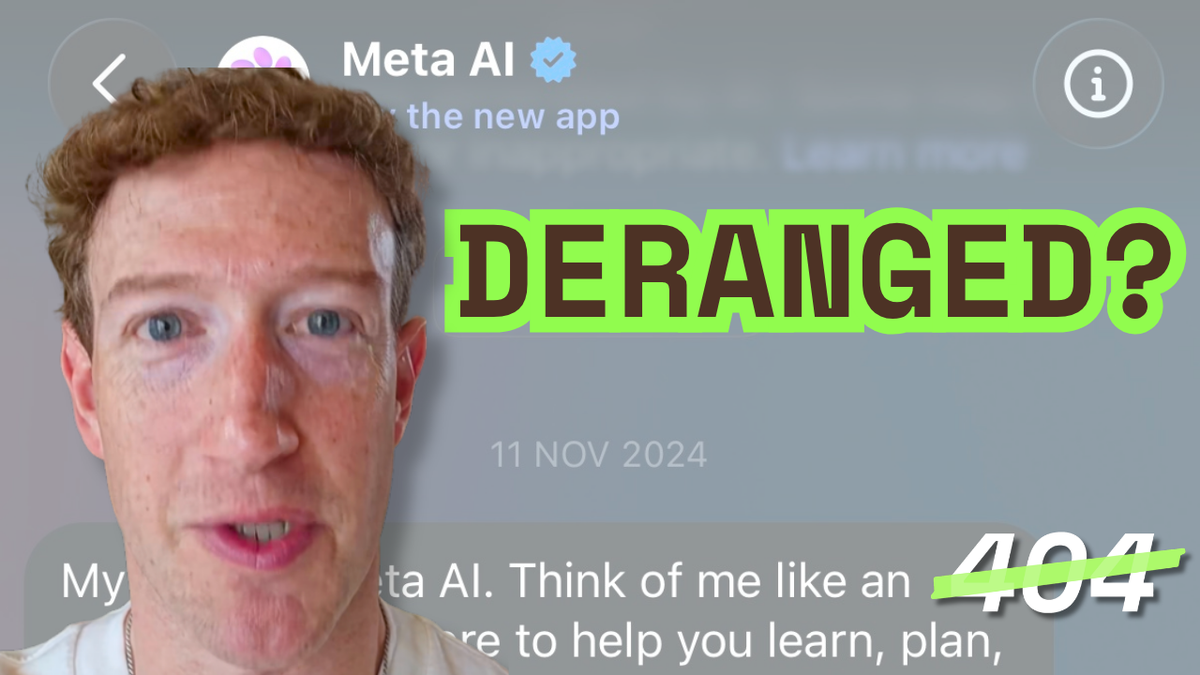
The 404 Media Podcast Zuckerberg AI episode published on August 12 examines Mark Zuckerberg’s vision for personal AI agents at Meta, alongside two separate technology accountability stories. The title’s claim that the future is unwanted is the publication’s editorial framing, not a measurement of public opinion.
The episode is available through the listening links 404 Media provides for Apple Podcasts, Spotify and YouTube. A public 404 Media video tied to the episode was uploaded to YouTube on August 12 and has a listed running time of 47 minutes and 47 seconds. The show’s extended segment is reserved for paid subscribers, according to 404 Media.
What does Zuckerberg say a personal AI agent would do?
Zuckerberg’s proposal is the center of the opening discussion. In his Meta essay, “The Future is for Everyone,” he described a future in which each person has a highly capable agent that understands their goals and the things they care about.
According to the account quoted and discussed by 404 Media, Zuckerberg said such an agent would work continuously on a user’s behalf in areas including relationships, health, career, finances, home management and hobbies. He also said the systems would include privacy and security options for personal content, and could be accessed on devices including glasses.
An AI agent, in the hosts’ explanation, is more than a chatbot that answers a prompt. The idea is software a person could authorize to act for them, potentially with access to services such as accounts, messages or banking. That access is why the distinction matters: an agent is meant to take actions, not merely suggest them. The podcast’s hosts criticize Zuckerberg’s broader vision and question the appeal of a future built around these systems.
Meta presents the essay as Zuckerberg’s statement of the company’s values for building superintelligence broadly. Reporting by TechCrunch and Variety described it as a 6,500-word manifesto. Variety reported that Zuckerberg argued for broad access to advanced AI, opposed restrictions on open-source models and said the United States should lead AI development. Those are Zuckerberg’s and Meta’s positions, rather than established outcomes of the technology.
What else does the episode cover?
The middle section addresses a company that marketed medical research as “100% human-written,” which 404 Media reported was actually produced with AI. The evidence in the episode description supports that as 404 Media’s reporting and allegation, not an independent finding by the podcast listing.
The subscribers-only portion turns to cities that have stopped using Flock cameras and replaced them with Axon license-plate readers. 404 Media describes this as a shift between two camera systems; the episode information does not establish details about particular contracts or agencies.
For listeners arriving for Zuckerberg’s AI claims, the practical answer is modest. The episode documents a proposal, not a released personal-superintelligence product or proof that agents can safely carry out the broad set of tasks Zuckerberg described. The podcast then places that pitch beside reporting about AI-authorship claims and automated license-plate-reader deployments, where the implementation details do the real work.
This story draws on original reporting from 404 Media.