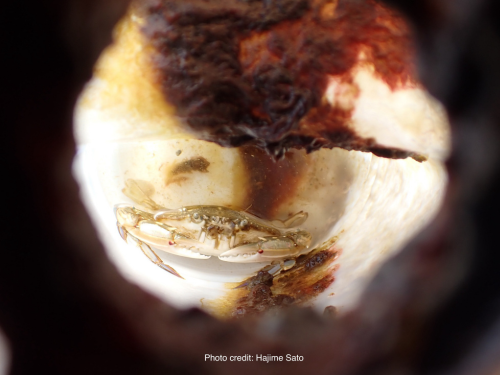
A crab trapped in a plastic bottle was recovered alive about 500 meters off Sesoko Island, Okinawa, on July 15, 2022, after the container had apparently floated at sea for roughly two months. The crab could not leave through the bottle’s narrow opening. A peer-reviewed study published in Ecosphere this year reconstructs how it likely survived long enough to grow into that predicament.
Hajime Sato, Yoichi Sakai and the late Tetsuo Kuwamura found the female three-spot swimming crab, Portunus sanguinolentus, during a boat survey of drifting objects used by juvenile fish. It was inside an uncapped high-density polyethylene bottle, meaning seawater could pass through, but the animal appeared unable to escape without help.
The physical mismatch was not subtle. According to the authors’ study, the bottle mouth was 24.0 millimeters across. The crab’s carapace measured 88.23 millimeters wide and 40.31 millimeters long. The researchers therefore infer that it entered when it was a larva or juvenile, then continued growing after it was inside.
How did the crab survive inside the bottle?
The team did not watch the crab’s voyage, so its account is a forensic reconstruction rather than a tracked route. Goose barnacles, Lepas anserifera, attached to the exterior supplied the clock: applying known barnacle growth rates, the researchers biologically estimated that the bottle had drifted for 62 days.
The food evidence came from the crab’s stomach. DNA metabarcoding identified rough triggerfish and Indo-Pacific sergeant, two of the fish species observed around the bottle. It also found green and brown algae. The authors say those algae most likely grew inside the container, providing another potential food source.
Four juvenile fish species were associated with the bottle when it was collected: rough triggerfish, rainbow runner, Indo-Pacific sergeant and freckled driftfish. Only the first and third were detected in the stomach analysis, so the study does not establish that every nearby fish became prey.
What does the finding show about plastic bottles at sea?
The paper documents what its authors describe as a previously unreported harm from floating marine debris to small crustaceans: a narrow-necked container can let a young animal enter, then become a one-way trap as it grows. Survival did not mean the crab was doing well. The researchers wrote that trapped animals may lack an opportunity to reproduce, which would prevent them from contributing to the next generation.
That conclusion should stay at the scale supported by the evidence. This is one documented animal, not a measurement of population-level harm to swimming crabs. The researchers also noted that evidence for an immediate, direct effect of drifting debris on crab populations remains limited. Still, the case identifies a mechanism that standard images of ocean plastic, usually nets and entanglement, do not capture: an ordinary bottle can become a floating enclosure for an animal small enough to enter and unlucky enough to keep eating.
This story draws on original reporting from 404 Media.