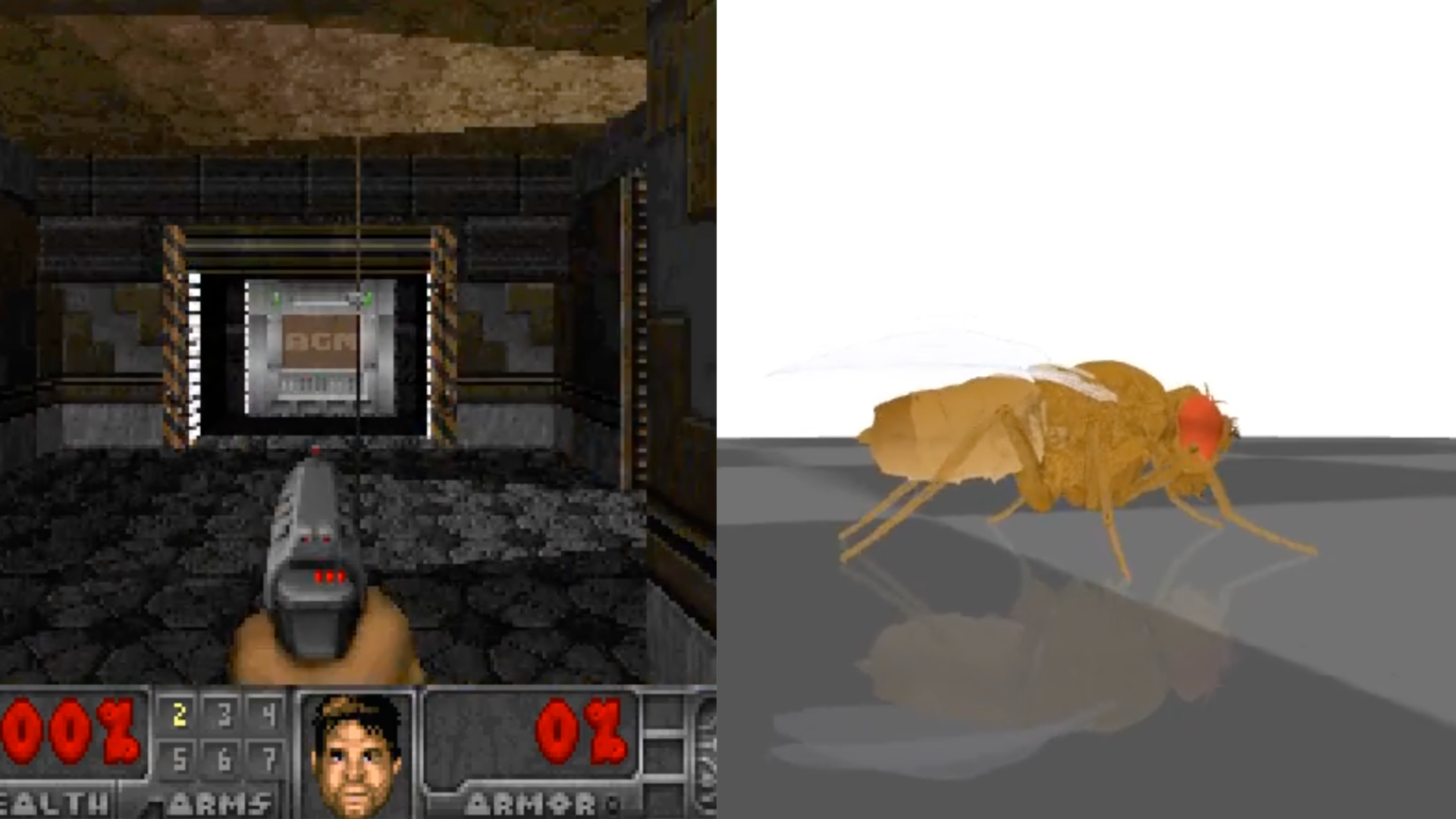
The digital fly brain is now steering through Minecraft, Doom and other online novelty projects after developers began using a newly released map of an adult male fruit fly’s nervous system. The clips are entertaining, and occasionally scientifically adjacent, but they do not show that anyone uploaded a living mind to a computer.
According to 404 Media, the resource behind the trend is MaleCNS v1.0, a connectome developed by HHMI Janelia Research Campus with Google Research and unveiled in September. The outlet reports that it maps more than 166,000 neurons in an adult male Drosophila fruit fly’s central nervous system.
The mapped system includes the central brain, optic lobes and ventral nerve cord, according to the project’s September 3 announcement cited by 404 Media. Those structures have rough functional parallels to a retina and spinal cord, respectively, but the comparison should not be stretched until it snaps.
What is the digital fly brain?
A connectome is a wiring diagram: it records which neurons connect, rather than reproducing an animal’s entire biological state. MaleCNS v1.0 maps neural structure and connections, but it does not contain the biochemical machinery of a living fly, 404 Media reports. The outlet says it is not capable of sentience or conscious perception in the biological sense.
That distinction gets lost once a connectome is placed inside a game. Georgia Tech computer-science graduate student Evan Sinclair Smith programmed the male connectome to drive a fly in Minecraft, 404 Media reported, and his September 4 post drew millions of views within a day. Other developers have shown versions in Doom and Beat Saber, along with demonstrations framed around bitcoin trading, parking and social behavior.
Those are developer-built virtual environments and tasks, not published evidence that the male model reproduces a real fly’s behavior. A game character moving after software translates simulated neural activity into controls says much about the adapter code and setup. It does not, by itself, validate the underlying model as a faithful animal simulation.
What has a fly connectome model actually predicted?
There is serious science underneath the meme pile. UC Berkeley reported in 2024 that the adult female FlyWire connectome contained 139,255 neurons and 50 million connections. It is a separate, sex-specific resource from the 2026 male central-nervous-system map, with different scope and neuron count.
In work published in Nature that year, a computer model based on the female wiring diagram predicted which neurons would activate when taste and touch sensors were stimulated, UC Berkeley reported. Simulated sugar or water input predicted activity associated with proboscis extension and feeding; simulated antennal input predicted a grooming-related circuit. Researchers then tested those predictions against real adult flies.
That is the useful dividing line. A connectome can support bounded predictions when researchers specify inputs and test outcomes. The viral projects may offer ways to explore the new data, but their claimed stunts do not establish biological fidelity, consciousness or a general-purpose artificial intelligence.
According to 404 Media, the male and female maps also allow researchers to compare neural wiring across sexes. UC Berkeley reported that scientists hope connectome-based models may help explain brain function, inform disease research and suggest ideas for AI. Those remain research ambitions, not demonstrated applications in humans.
This story draws on original reporting from 404 Media.