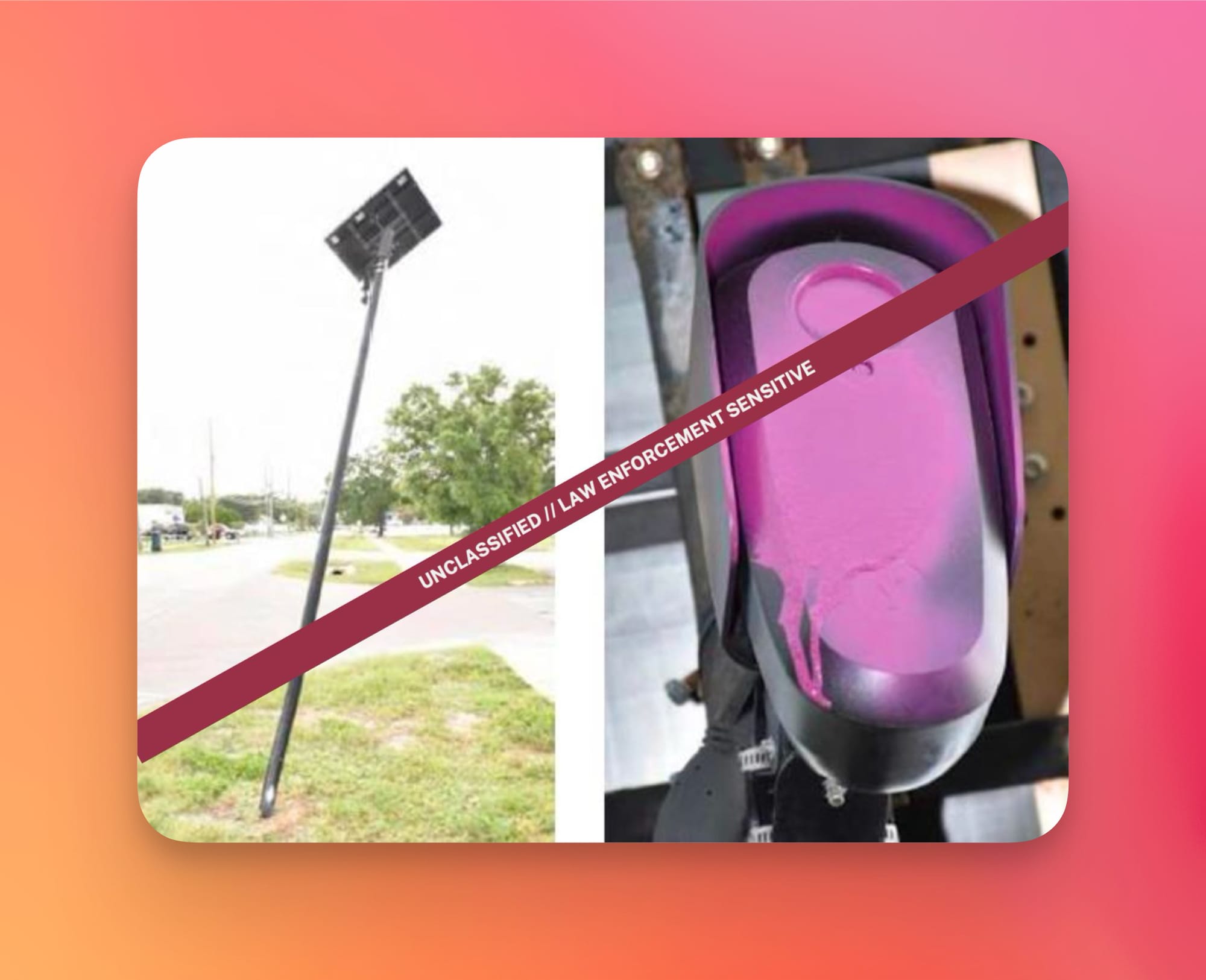
Law-enforcement fusion centers are tracking public posts and planned events tied to opposition to Flock Safety cameras, according to intelligence bulletins obtained by 404 Media through public-records requests. The government monitoring anti-Flock accounts matters because the briefings reportedly combine ordinary political organizing with warnings about alleged efforts to damage the cameras.
404 Media said it obtained four recent briefings in addition to documents first published by investigative journalist Dan Boguslaw. Fusion centers are information-sharing arrangements linking local, state and federal law-enforcement agencies. The materials are intelligence bulletins circulated to police, and many were marked Law Enforcement Sensitive, according to the outlet.
The reported bulletins flag viral Instagram content, discussion on TikTok and Facebook, alleged vandalism of automatic license-plate readers, tools that could help identify camera locations, and DeFlock's National Week of Action Against Automated License Plate Readers, scheduled for August 16 through 22.
What are police monitoring in anti-Flock accounts?
A Colorado Information Analysis Center bulletin said public accounts were posting videos of people allegedly disabling or destroying ALPR cameras, 404 Media reported. It specifically named the Instagram account Nomark.Project, which the bulletin said posted daily videos claiming to show Flock cameras being taken down or disabled.
The same Colorado briefing reportedly referred to recruitment calls by the neo-Nazi accelerationist group Private Aryan Resistance to sabotage Flock cameras, while stating the effort had lost traction. 404 Media said the document did not say that the group had actually targeted cameras.
A separate bulletin from the Wisconsin Statewide Intelligence Center, distributed through the Northeast Florida Fusion Center, described continuing Facebook and TikTok discussion about interfering with Flock license-plate readers or disrupting their connectivity. It also referenced a June 25 traffic stop by the University of South Florida Police Department in which officers found a device they said could identify Flock-camera locations. The bulletin said the driver was involved in DeFlock and had released software for scanning internet-connected devices for vulnerabilities, according to 404 Media. The available reporting does not establish the driver's intent, whether charges were filed, or the outcome of that case.
What the bulletins do and do not show
DeFlock is an open-source, crowdsourced map of ALPR cameras created by Will Freeman, according to 404 Media. The outlet describes the broader movement as a loose collection of local activists seeking to inform their communities and press officials to reconsider Flock contracts. DeFlock describes its August events as public meetings, town halls, marches and other awareness efforts.
That is political activity. It is distinct from property damage, even though the bulletins reportedly present both in the same threat picture. The Guardian identified at least 33 apparent incidents in 23 states in which Flock cameras were damaged, vandalized or destroyed in ways that appeared motivated by opposition to surveillance. That count does not demonstrate that DeFlock organizers or participants directed, endorsed or carried out those acts.
ALPR cameras photograph passing vehicles and can record details such as a plate number, make, model and color. PBS reported that a Flock representative said the company stores the data in a searchable cloud database for 30 days and uses it to alert police about vehicles on law-enforcement lists. Flock has said its products are not mass-surveillance tools and cannot track vehicles or people. The ACLU disputes that framing, arguing that Flock and similar systems enable broad surveillance with inadequate oversight.
The reported bulletins support a narrower conclusion than their sweep might suggest: authorities were watching public anti-Flock speech, scheduled advocacy and reports of possible sabotage. They do not, on the material available, establish criminal conduct by peaceful protest participants or surveillance of every person who criticizes the company online.
This story draws on original reporting from 404 Media.