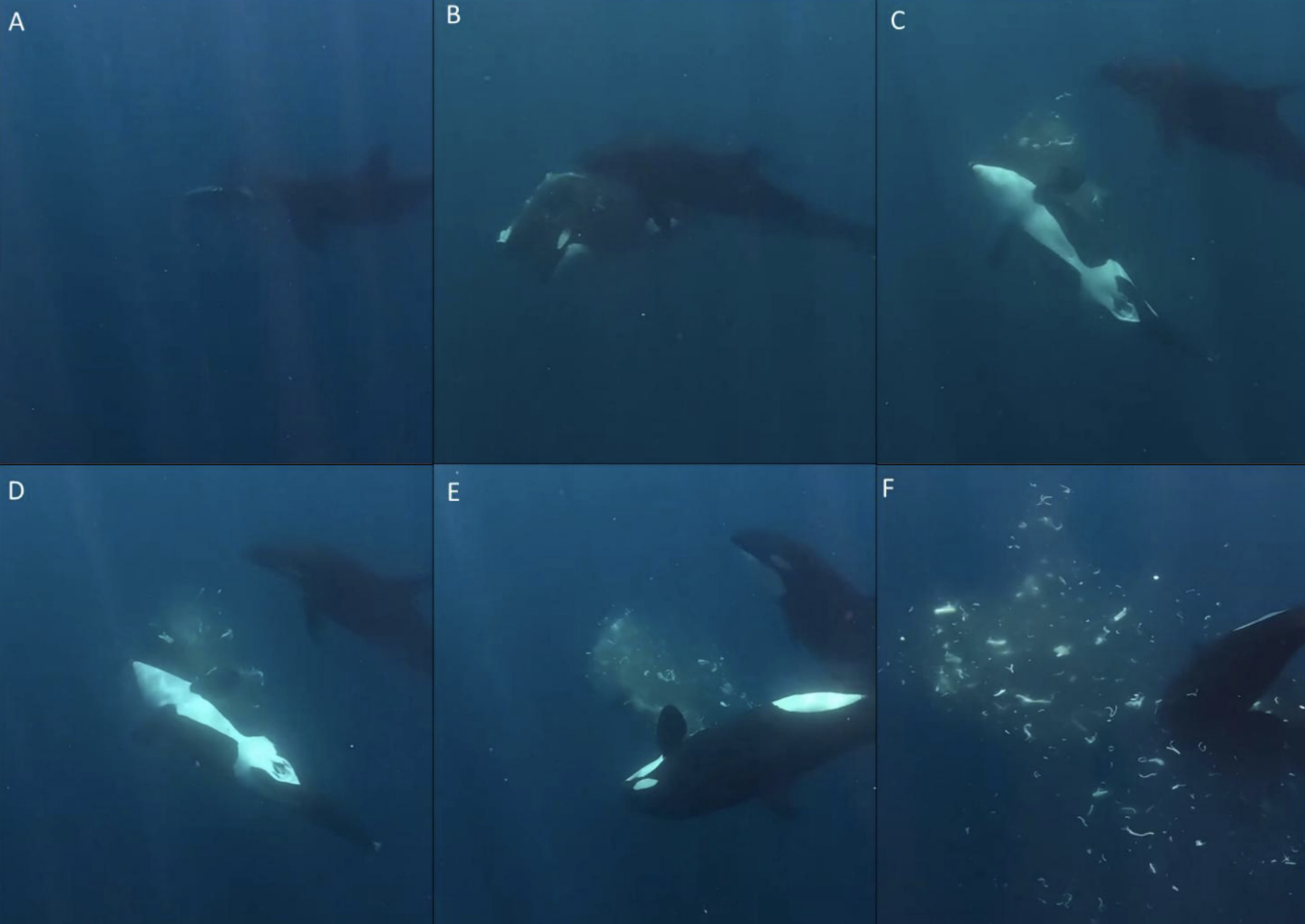
Researchers studying orcas in the Gulf of California have documented a behavior they say has not been reported before: one whale holds up a dead sunfish while another accelerates into it, breaking the carcass into small pieces that younger animals can eat.
The observations appear in a study published Thursday in Frontiers in Ethology. The team, including wildlife cinematographer and marine biologist Erick Higuera, argues that the behavior may help calves and juveniles access tissue from a prey animal that is large, awkward, and hard to tear apart. The researchers also say it may function as practice or play, a cautious interpretation given orcas’ well-documented habit of manipulating prey.
Orcas already have a résumé for impact work. Some groups hit prey during hunts, and certain pods have become known for striking boats. The Gulf of California footage adds a different use of force: a coordinated hold-and-ram maneuver that turns a sunfish carcass into loose tissue rather than just subduing it.
Higuera first saw the behavior in 2021. Marine biologist Kathryn Ayres captured another event in 2024, and Héctor Franz, who works in ecotourism, filmed a further incident in 2025, according to the study. Higuera told 404 Media that the impact was loud enough to hear from the boat, and that the amount of tissue thrown off made clear the team was seeing something unusual.
Why sunfish make sense as target practice
Sunfish are large animals, with some reaching around two meters depending on species, but they are slow and poorly defended compared with many other prey. That makes them attractive to predators. Their bodies also present a mechanical problem: the flesh is tough and rubbery, which can make feeding difficult for young orcas.
The researchers’ explanation is practical. Adults can strip organs and larger pieces from the carcass, while juveniles can take smaller fragments produced by the collision. In that reading, the ramming is food processing by whale, messy but effective.
The study also leaves room for a social function. Higuera told 404 Media that sunfish provide a low-risk object for subadult orcas to practice accurate strikes and social coordination. He described the behavior as social play and learning, while noting that orcas are known globally for object manipulation and play with prey.
A less mapped orca population
The finding also matters because Gulf of California orcas are less neatly categorized than the better-studied northeastern Pacific lineages. In that region, researchers distinguish resident orcas that mainly eat fish, transient orcas that mainly hunt marine mammals, and offshore orcas that prey on sharks. Higuera’s team says lower-latitude orcas do not fit as cleanly into those ecotypes, leaving more basic behavior to document.
The researchers used drones, underwater cameras, and footage from collaborators to study the pod. Higuera said the group plans to keep tracking the animals and investigate whether sunfish microbiomes or enzymes offer nutrients relevant to orcas.
He also warned that documentation should not turn into harassment. Whale watching has grown in the region, and Higuera said researchers, ecotourism operators, and citizen scientists can help record rare behavior only if they keep a respectful distance from the animals.
This story draws on original reporting from 404 Media.