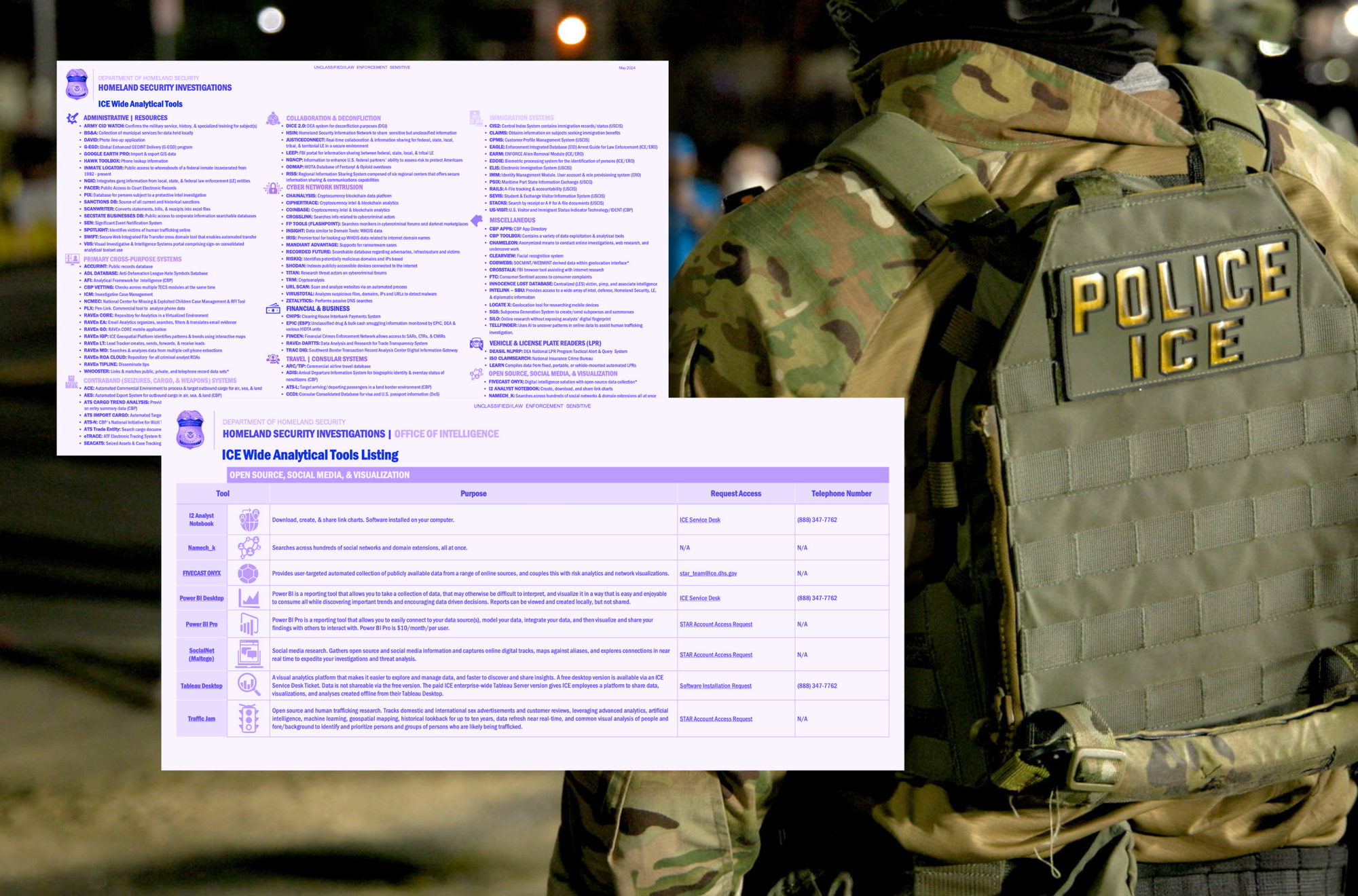
Immigration and Customs Enforcement employees had agency-wide access to a catalog of surveillance and investigative tools as of May 2024, according to an internal document published by 404 Media. The list matters because it puts many of ICE’s data pipes in one place: phone-derived location tracking, social media monitoring, facial recognition, insurance claim databases, vehicle movement tools and systems for undercover online work.
The document, titled “ICE Wide Analytical Tools,” is a rare public inventory of capabilities available across the agency, rather than a narrow look at one office or one contract. It does not prove every listed tool remains available now. The document is dated May 2024, and 404 Media noted that ICE’s current access may have changed.
A Department of Homeland Security spokesperson told 404 Media, after being sent screenshots, that “Like other law enforcement agencies, ICE employs various forms of technology to investigate criminal activity and support law enforcement efforts.”
What the list includes
Several entries describe products built from commercial data sets that were not originally created for immigration enforcement. That is the part worth reading closely, because a phone app, an insurance claim or a data broker record can become an investigative lead once the government buys access to the right interface.
Accurint, from LexisNexis, is described as a people-location tool. 404 Media reported that it can include addresses, phone numbers, Social Security numbers and other personal data.
Locate X, made by Babel Street, lets investigators search location data harvested from smartphones, according to 404 Media. The outlet reported that the data comes through ordinary apps and the advertising ecosystem. The ICE document says investigators can draw a digital boundary around a place and identify mobile devices that were inside it from mobile data sources.
Chameleon is listed as a way to conduct online research, investigations and undercover work while remaining anonymized.
Cobwebs is described as a social media monitoring tool. 404 Media previously reported that Cobwebs includes Webloc, a capability used to monitor phone locations across neighborhoods.
ISO ClaimSearch is an insurance database. 404 Media reported that it contains details from more than 1.8 billion property and casualty insurance claims and 58 million medical bills.
The list also covers tools for monitoring social media and tracking vehicles, according to 404 Media. The practical effect is a search layer over pieces of daily life that people rarely think of as one database: where a phone has been, what a person posted, where a car traveled, what claims were filed and which public or brokered records tie those signals to a name.
What is missing
The document is not a full map of ICE surveillance. 404 Media reported that it excludes capabilities available only to specific parts of the agency. For example, it does not list ELITE or ImmigrationOS, two Palantir-built tools the outlet previously reported on.
Instead, the May 2024 list names RAVEn, a Homeland Security Investigations system developed internally before ICE hired Palantir to build a newer suite of tools. One entry, RAVEn IGP, is described in the document as ICE’s geospatial platform. According to the document, it lets users identify patterns and trends with interactive maps showing events by place and time, and is available to all ICE employees.
404 Media also reported that ICE has continued to spend hundreds of millions of dollars on personal data and surveillance technology. The May 2024 inventory is therefore a snapshot, not a ceiling. It shows what ICE said its employees could reach then, while leaving open what has been added, removed or restricted since.
This story draws on original reporting from 404 Media.