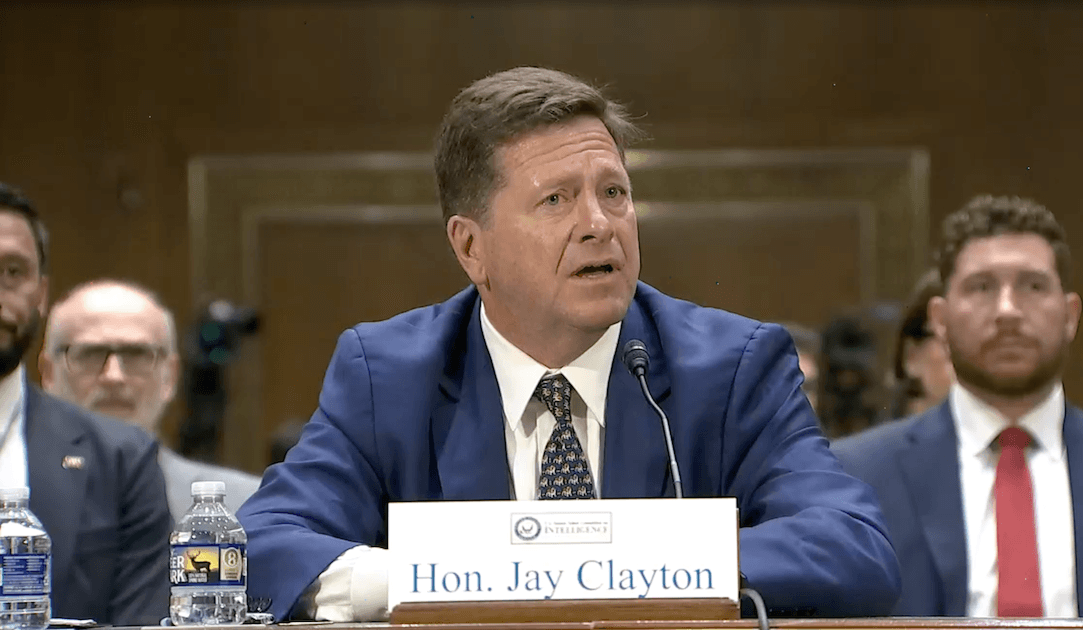
The Jay Clayton DNI confirmation cleared the Senate on Tuesday, putting the former Securities and Exchange Commission chair and current U.S. attorney for the Southern District of New York in charge of the Office of the Director of National Intelligence after a bruising delay-filled process.
Senators voted 51-47 to confirm Clayton as director of national intelligence, with the vote falling along party lines. His nomination had been stalled after President Donald Trump abruptly canceled Clayton’s first confirmation hearing.
Clayton takes over an office built to coordinate the country’s nearly 20 intelligence agencies. That job now comes with a personnel fight attached: Bill Pulte, the temporary intelligence chief appointed last month, said on social media ahead of the vote that ODNI would cut another 30 percent of its staff.
Pulte is a strong Trump ally and has no military or intelligence background. The size of ODNI’s workforce is classified, but the latest reduction, combined with a 40 percent cut claimed by former Director of National Intelligence Tulsi Gabbard, most likely leaves the office with fewer than 1,000 employees.
Republicans have supported the reductions, saying Congress intended ODNI to stay lean when it created the office after the Sept. 11 attacks. Democrats have treated the cuts and the interim leadership as signs of instability at the top of the intelligence system.
What does the director of national intelligence do?
The director of national intelligence oversees and coordinates the U.S. intelligence community rather than running a single spy agency. The office is supposed to set priorities, manage information-sharing and help ensure that agencies with different missions are not working at cross-purposes.
That makes the job bureaucratic, political and operational all at once. A weak DNI can become a traffic cop without traffic lights; a strong one can shape what the president and Congress see about threats from foreign governments, cyber operations, terrorism and emerging technologies.
Clayton initially drew some bipartisan goodwill because of his legal career and prior government service. That changed during his confirmation hearing, when Democrats pressed him over his repeated refusal to say that Joe Biden won the 2020 presidential election.
Democrats argued those answers raised doubts about whether Clayton would protect intelligence judgments from political pressure. He also faced questions about subpoenas issued to journalists while he served in Manhattan and about how he would defend the intelligence community’s independence.
The Senate Intelligence Committee advanced Clayton’s nomination last week, also on a party-line vote. On the Senate floor before final confirmation, Intelligence Committee Chairman Tom Cotton, Republican of Arkansas, said Clayton had pledged to work with the panel to secure funding for intelligence agencies.
Cotton said committee staff had identified shortfalls and that he projected any supplemental appropriations bill or reconciliation bill would need about $40 billion for intelligence agencies. He referred to reconciliation, a budget process that can bypass the 60-vote filibuster and pass spending legislation with a simple majority.
Sen. Mark Warner of Virginia, the top Democrat on the Intelligence Committee, said he was encouraged when Clayton was first nominated but left the process with serious concerns about whether Clayton would stand up to political pressure. Warner said he hoped Clayton would prove those concerns wrong because the intelligence community needed steadier leadership than it had received in recent months.
Clayton inherits a crowded threat list. The United States is competing with China over artificial intelligence, preparing for possible foreign interference in upcoming midterm elections and the 2028 presidential race, and dealing with the fiscal strain of a war with Iran that has entered its sixth month.
Congress has also allowed Section 702 of the Foreign Intelligence Surveillance Act to lapse. National security officials have described that surveillance authority as one of the intelligence community’s most valuable collection tools, but it expired after Democrats objected to Pulte’s appointment.
This story draws on original reporting from The Record.