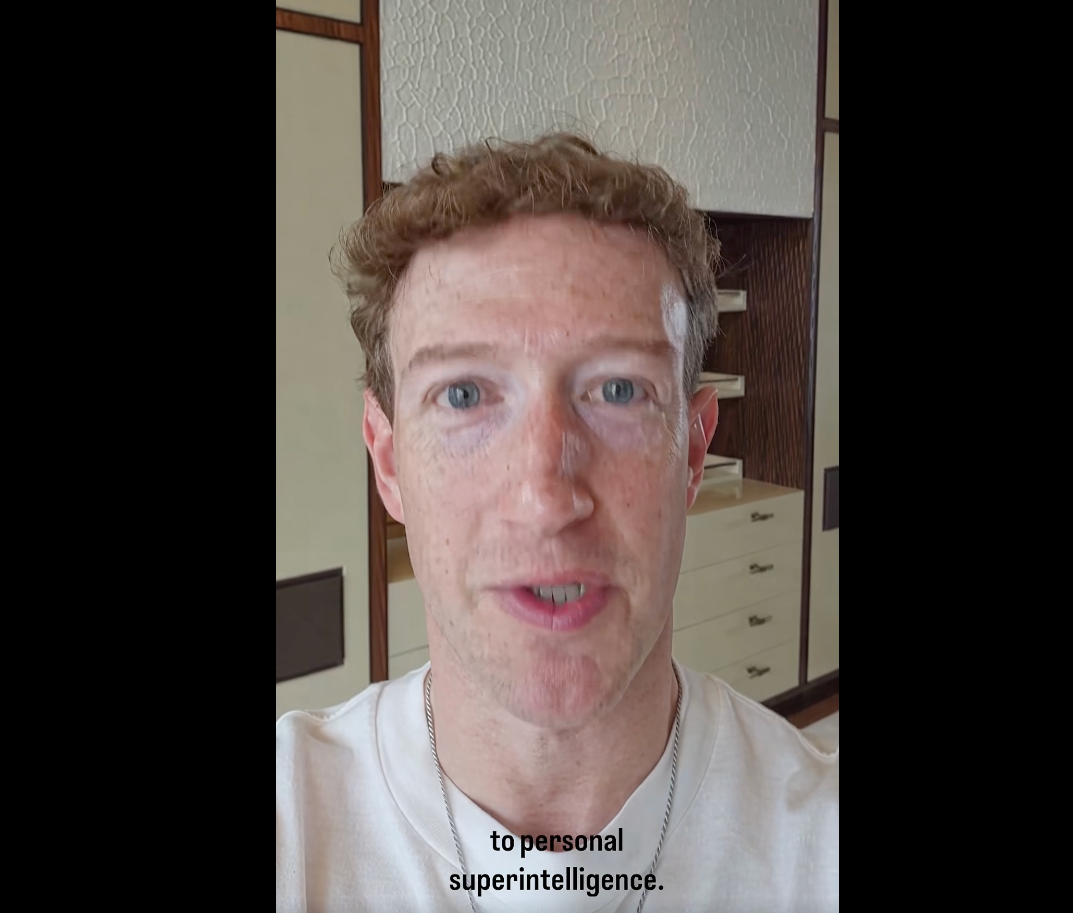
Mark Zuckerberg’s AI future for everyone argument is a case for putting highly capable AI tools in individual hands rather than leaving them under the control of a small group of companies or institutions. In a Wall Street Journal opinion essay published July 28, Meta’s chief executive called that approach “personal superintelligence,” a prediction and policy view, not a product that has been shown to exist.
Zuckerberg argues that access to AI beyond human capabilities could let people create things, start businesses, learn concepts and improve parts of their lives. He frames the choice as one between concentrated control and broad personal access, saying a handful of institutions with superintelligence would, in his view, inevitably exercise a controlling influence over economics, science and politics.
What does Mark Zuckerberg mean by personal superintelligence?
In Zuckerberg’s formulation, personal superintelligence is AI configured around an individual’s goals and preferences. The New York Times described his proposal as AI bots tailored to people’s needs and desires. In the essay, Zuckerberg says the central role for such systems should be invention rather than replacing existing work.
His examples are deliberately expansive: AI might help discover medicines or improve a business. He also offers a legal hypothetical. One person with a superintelligent lawyer would have an unfair advantage, he writes, while universal access to one could make the justice system fairer and more efficient. That is an argument about a possible future, not evidence that equal access would produce that result.
404 Media reported that Zuckerberg also envisioned personal agents that could handle tasks across areas including health, relationships, careers, finances and hobbies. The outlet quoted him describing an agent that flags information, helps prototype ideas, monitors his sleep and helps plan recipes with his daughter.
Why does Zuckerberg oppose centralized AI control?
Zuckerberg’s case rests on individual autonomy and on the claim that no single AI system can represent conflicting human values. He writes that people should be able to decide what matters to them, rather than have a superintelligent system or a small group of experts make those decisions.
He also treats distributed access as a safety check. For cybersecurity, Zuckerberg says the history of open-source software suggests broad access to powerful systems can improve safety and security over time. He draws a different line for biological risks, saying governments and other institutions should coordinate on responsible deployment of capable models.
The supplied excerpt does not specify how such coordination would be enforced, nor does it lay out operational limits for public access. It does, however, state Zuckerberg’s distinction between cybersecurity and biological-risk deployments.
What are the criticisms of Zuckerberg’s essay?
404 Media’s headline called the essay “deranged,” an editorial judgment rather than a factual description. Its reporting argued that the vision did not adequately account for harmful or unwanted uses of AI agents, and questioned claims around access, data centers and social effects. Those objections are the outlet’s critique of Zuckerberg’s proposal, not findings established by the essay itself.
Zuckerberg’s essay is therefore best read as Meta’s CEO staking out a philosophy: AI capability should be broadly available and personalized, with invention prioritized over automation. Whether the technology reaches the capability he predicts, and whether distributing it would create the safeguards he expects, remain open questions.
This story draws on original reporting from 404 Media.