The Summer of Ludd NYC festival turned anti-tech politics into a week of free, offline public events, according to 404 Media, with organizers avoiding websites and social platforms while urging New Yorkers to meet, dance, learn and argue in person.
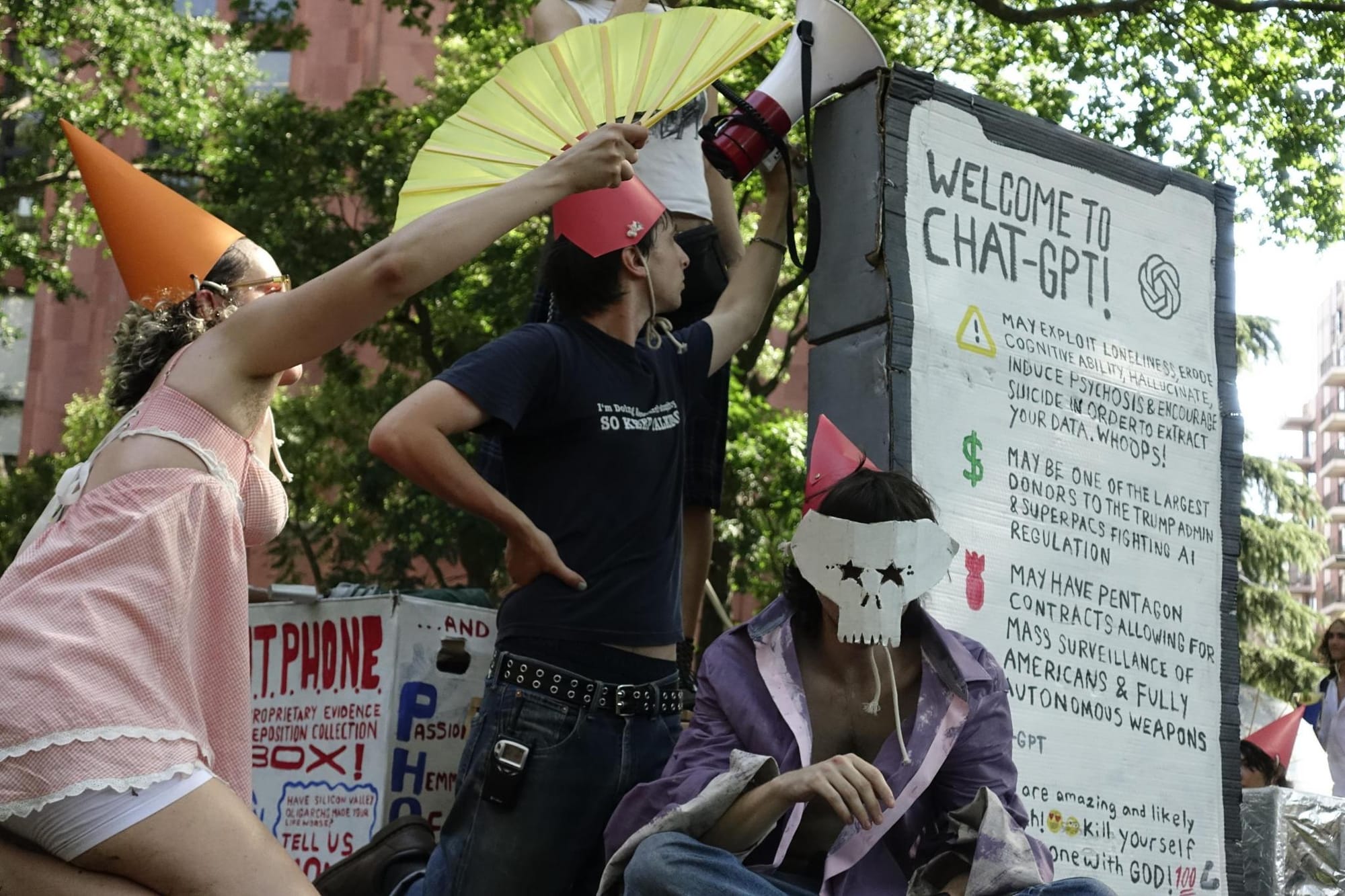
The week included a Lower Manhattan march during Fourth of July weekend where about 100 people in homemade pointy hats chanted against AI and carried a cardboard smartphone labeled “ChatGPT” toward Washington Square Park. There, participants staged a mock trial of OpenAI and CEO Sam Altman, accusing the company of harms including training models on artists’ work, AI-related mental health problems and the energy demands of data centers, 404 Media reported.
The protest was the fourth version of an event the group calls “S.H.I.T.P.H.O.N.E,” short for “Scathing Hatred of Information Technology and the Passionate Hemorrhaging of Our Neo-liberal Experience.” The absurd acronym is doing a lot of work, but the organizing logic was straightforward: make a public spectacle that cannot be flattened into a neat platform campaign without losing the point.
What is Summer of Ludd in NYC?
Summer of Ludd is a week-long New York festival run by an anonymous loose collective calling itself the Luddite Renaissance, according to 404 Media. Its premise is that people can build social life and political action without leaning on Big Tech platforms, recommendation feeds or the usual engagement bait machinery.
The festival had no website. People could call a phone number for the daily schedule, or hear about events through posters, paper guides placed in bookstores and coffee shops, mailing lists such as NYC Off Tech, and word of mouth.
Events listed by 404 Media included an “offline rizz” workshop meant to help people move beyond dating apps, a phone-free rave called “Let’s Get Off Together,” internet piracy 101 sessions and an outdoor play about the original Luddites. Organizers also used Tompkins Square Park as a physical hub, offering free food, zines and information about events around the city.
Why the organizers kept it off platforms
The Luddite Renaissance explained its approach through a paper-only zine manifesto called “The Event is the Medium,” a nod to Marshall McLuhan’s “the medium is the message,” 404 Media reported. The group asked that its work not be uploaded to social media.
The manifesto argues for public events that are free, participatory and hard to package. The goal is to create gatherings that resist the logic of short-form feeds, where messy human activity gets clipped, ranked, monetized and sold back as culture.
At a press conference in Tompkins Square Park, the group used a garbage-made puppet named Gowanus as its “media spokespuppet” to preserve organizer anonymity, according to 404 Media. Journalists were asked to sign a long paper “Terms of Service” saying their recordings could not be turned into short-form video such as TikToks or Instagram Reels.
One organizer identified as Bucky told the crowd that activists had become attached to chronically online culture even as platforms track consumer behavior and sell attention back to users. Bucky argued that public space, not social media, is where politics happens, citing Tahrir Square as an example of mass action rooted in physical proximity rather than platform magic.
The event also drew familiar New York media and protest figures, according to 404 Media, including Motherboard founder Alex Pasternack, journalist Taylor Lorenz and Reverend Billy of the Church of Stop Shopping.
The festival’s critique is broad: AI systems, smartphones, surveillance advertising, dependency-by-design apps and the cultural habit of turning every gathering into content. Its tactic is narrower and harder to monetize: show up somewhere, put the phone away and see who else came.
This story draws on original reporting from 404 Media.