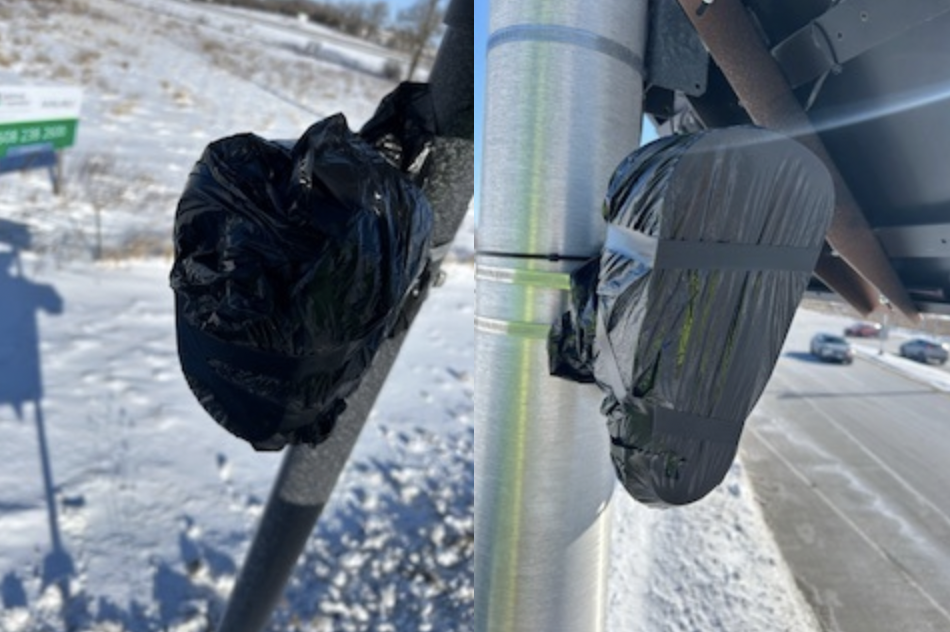
Officials in Verona, Wisconsin, put black plastic bags over three Flock Safety license-plate cameras after weeks of trying to get the company to take the hardware down, according to emails obtained by 404 Media through a public-records request.
The records show the awkward mechanics of ending a surveillance contract when the cameras are still bolted to local streets and the vendor still owns them. Verona’s Common Council had voted on November 10 not to continue its deal with Flock, following reporting by 404 Media and others that described Flock data being shared with federal agencies, including cases where local police used the system in connection with Immigration and Customs Enforcement.
At that meeting, council members said their concern was Flock, rather than Verona police. Council president Mara Helmke said Flock was “not trustworthy,” according to 404 Media. Alderman Spencer Harrison said the company’s assurances that Verona controlled its data were not enough.
The next day, alderman Beth Tucker Long asked city staff to notify Flock that Verona would not renew. She also asked when Flock would remove its equipment and whether the city could shut off or disable the cameras while it waited.
City officials considered taking the cameras down themselves
By mid-January, the cameras were still standing. A Verona resident emailed a council member on January 15 to say at least two cameras, near Costco and a park-and-ride, remained in place. The resident asked whether they were operating and suggested covering them with opaque bags if removal was delayed.
On January 16, Flock sent Verona an automated notice saying it planned to “replace equipment” at one camera site. Police chief David Dresser wrote that he hoped the message meant Flock was preparing to uninstall the cameras, adding that the city had asked at least twice for removal, according to the emails.
Mayor Luke Diaz then asked whether anything stopped Verona from taking down the cameras and storing them at City Hall until Flock collected them. A staffer relayed Diaz’s request to city employees. A public works employee replied that crews could remove the cameras and solar panels and store them, though poles or posts might have to wait until spring.
Diaz wrote that he did not see anything in the contract preventing the city from removing the equipment and noted that the contract had expired, according to 404 Media.
A police officer then asked city staff to wait until he spoke with Flock. He wrote that if the company objected, he would demand immediate remote shutdown and quick removal, and tell Flock the city would remove the equipment anyway if necessary.
Flock objected, and the bags went up
After that call, the officer told city officials that Flock had objected to Verona removing the cameras. He said a Flock representative promised to seek an expedited removal order, but was unfamiliar with the process. The officer also asked Flock to terminate the camera network remotely and said the representative was not sure whether that was possible or how to do it.
The officer recommended covering the cameras with black plastic bags for the time being. Public works said it would do so, and on January 23 reported that the cameras had been covered, according to the emails.
Flock later sent more automated work-order messages. One said a work order had been resolved and that the device “should not be functioning normally,” according to 404 Media. Another listed two cameras for removal and one for regular maintenance. Flock’s work-order language said removals generally take two to three weeks, with service times varying.
Verona police also told officers not to treat the bagged cameras as vandalism. In an email titled “RIP Flock Cameras,” an officer said the Department of Public Works had covered them and that, once covered, they would not read plates.
Flock removed the cameras on February 4.
A Flock spokesperson told 404 Media that the company leases cameras to customers and handles installation, maintenance, and removal because the hardware remains Flock property. The spokesperson said Flock has a defined offboarding process and can remotely deactivate cameras at any time if an agency asks.
For Verona, Flock said the council chose not to renew rather than cancel mid-contract. The company said Verona had two agreements, covering two license-plate readers and one license-plate reader, expiring in April 2026 and July 2026, and that Flock coordinated removal under its standard process after the city asked.
This story draws on original reporting from 404 Media.