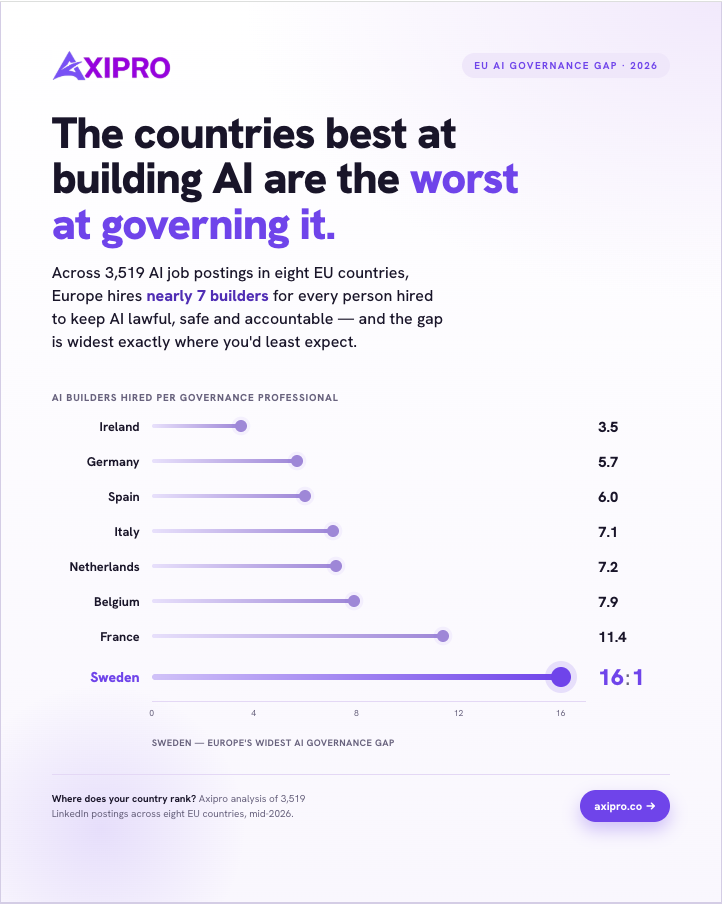
European employers are staffing AI product work far faster than the functions meant to keep those systems documented, assessed and disclosed under the EU AI Act.
Axipro, a compliance firm, reviewed 3,519 AI-related job postings across eight EU countries and found roughly seven roles for building AI systems for every one role focused on governing them. That ratio is an HR statistic with an engineering aftertaste: transparency and documentation work does not appear at the end of a sprint because someone in legal remembered a deadline.
The imbalance is sharpest in Sweden, where postings showed 16 builder jobs for every governance job. France followed at 11 to one. Ireland had the narrowest gap at 3.5 to one, which Axipro attributed partly to US technology companies in Dublin carrying over governance practices from global compliance programs.
The timing is awkward. Axipro said the Digital Omnibus, approved by the Council on 29 June, pushed the AI Act’s high-risk regime to December 2027. But Article 50 transparency obligations still begin on 2 August 2026, and penalties of up to €35 million or 7% of global turnover remain unchanged.
That distinction matters for companies that have treated the AI Act as a later problem. Article 50 obligations force operational questions earlier: which products use AI, where users need disclosures, how generated or manipulated content is labeled, and who owns the evidence trail when regulators ask. Those are product, data, security and compliance tasks, not a policy PDF waiting to happen.
Axipro’s study also found that fewer than three in ten governance job ads mention the AI Act. Even when employers are hiring people with governance titles, the roles may not be aimed at the law’s specific workload, including conformity assessments and technical documentation.
Ali Hayat, Axipro’s founder and chief executive, said job postings show where budgets are actually going. “98.5% of organizations tell researchers their AI governance staffing is inadequate, yet their hiring budgets are flowing to the side of the business that creates regulatory exposure, not the side that manages it,” he said. Hayat added that recruiting a governance hire can take months and that assembling documentation for the Act can take much of a year.
The pattern is uneven by sector. Nearly half of governance postings came from companies with more than 5,000 employees, and two-thirds came from financial services and IT consulting, according to the study. Those sectors already have compliance departments that can be extended to AI oversight, even if the technical details differ.
Healthcare and government administration, two areas facing serious obligations under the Act, each posted only four governance roles across the eight countries during the period studied. That is the kind of number that turns “AI readiness” from a board-slide phrase into a queue of unresolved model inventories, vendor checks, disclosure text and audit evidence.
The labor market is already pricing the shortage. Axipro cited the VerifyWise AI Governance Salary Report 2026, which put independent AI governance consultant day rates in mature markets at $800 to $2,000 and said demand rose 150% year over year.
For employers, the bottleneck is not only finding lawyers who can read the regulation. The harder problem is hiring people who can translate Article 50 into product requirements, logging, documentation and release gates before August 2026. Axipro’s EU AI Act hiring gap study suggests many companies are still spending as if the builders can outrun the paperwork.