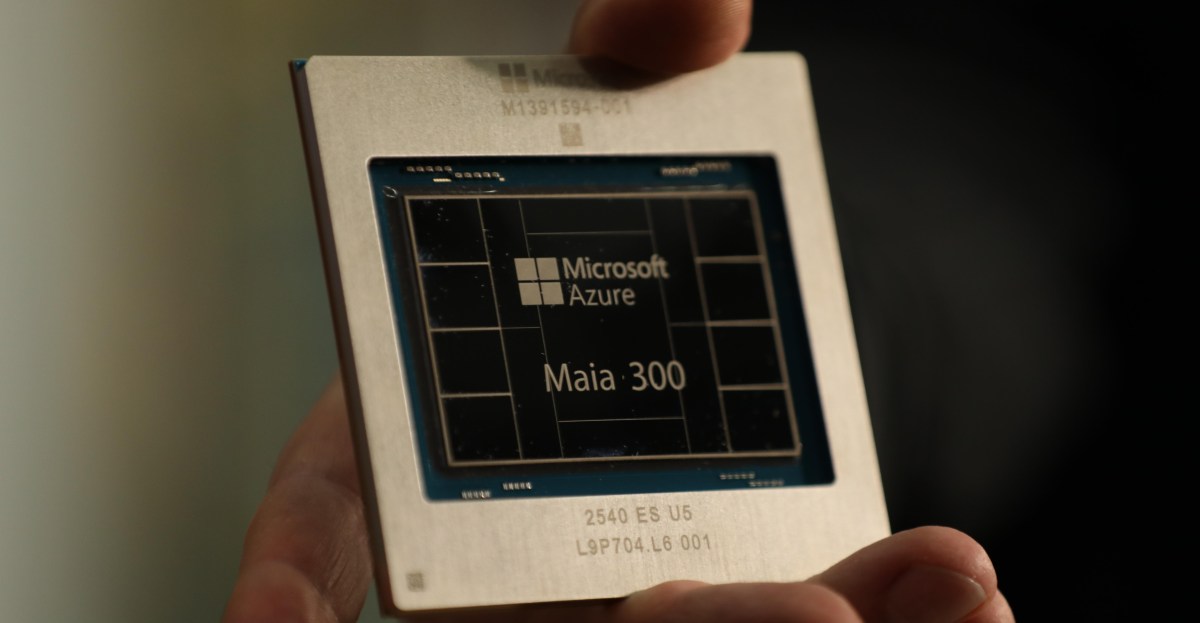
Microsoft’s Maia 300 plan is a bid to move more of the AI requests behind Copilot and other company services onto hardware it designs, rather than a declaration of independence from Nvidia. The company announced Oct. 12 that production deployments of its third-generation AI accelerator will begin in 2027 and that Maia is intended to become the primary inference system for Microsoft products and services.
That is a meaningful shift in workload sourcing, if Microsoft delivers on it. Inference is the company’s term for running AI services to handle incoming requests. Microsoft says Maia 300 is designed for long-context reasoning, time-sensitive conversational products and multistep agent tasks.
Scott Guthrie, Microsoft’s executive vice president for Cloud + AI, said the company will scale the Maia family to multi-gigawatt deployments beginning in 2027. The planned rollout follows Maia 200, which Microsoft says is already in production for workloads including Microsoft Copilot. GitHub Copilot and Microsoft Foundry are expected to follow Maia 200 by the end of the year, according to Microsoft’s announcement.
Will Maia 300 replace Nvidia GPUs at Microsoft?
No, at least not on the evidence Microsoft has provided. CNBC reported that Alistair Speirs, a Microsoft general manager, said the company wants flexibility to deploy the appropriate silicon for the models it is running. Speirs also said Microsoft partners with Nvidia and AMD for model training.
Microsoft already operates substantial Nvidia infrastructure. In a 2025 Azure post, the company said it had deployed a production cluster with more than 4,600 Nvidia GB300 NVL72 systems for OpenAI workloads and planned to expand to hundreds of thousands of Blackwell Ultra GPUs across its AI data centers. Those systems are intended for both training and inference workloads.
The distinction matters because Microsoft’s announcement assigns Maia a particular job: serving AI requests. It does not say the company will stop buying Nvidia hardware, and Maia accelerators are not available for outside customers to rent by the hour, unlike some competing cloud chips.
What Microsoft claims Maia 300 can do
Microsoft says Maia 300 will produce 40% more tokens per megawatt than leading GPU-based systems. It also claims that a full configuration of 96 accelerators can deliver up to seven times Maia 200’s rack-scale token throughput. Those are Microsoft performance projections, not independent benchmark results.
The company attributes the expected efficiency gains partly to a multi-chiplet layout that separates compute, memory-controller and input/output functions. Maia 300’s compute chiplets are to be made on TSMC’s N2P process, Microsoft says. A full rack is designed to hold 96 accelerators in a 167-kilowatt power envelope.
Microsoft designs the Maia chips and TSMC manufactures them. Whether the new hardware cuts Microsoft’s Nvidia spending at the scale implied by the announcement remains unproven. Evercore ISI analysts estimated Maia would account for about 10% of Microsoft’s AI-chip spending by the first quarter of 2027, CNBC reported. That is an analyst estimate, not Microsoft guidance.
This story draws on original reporting from The Verge.