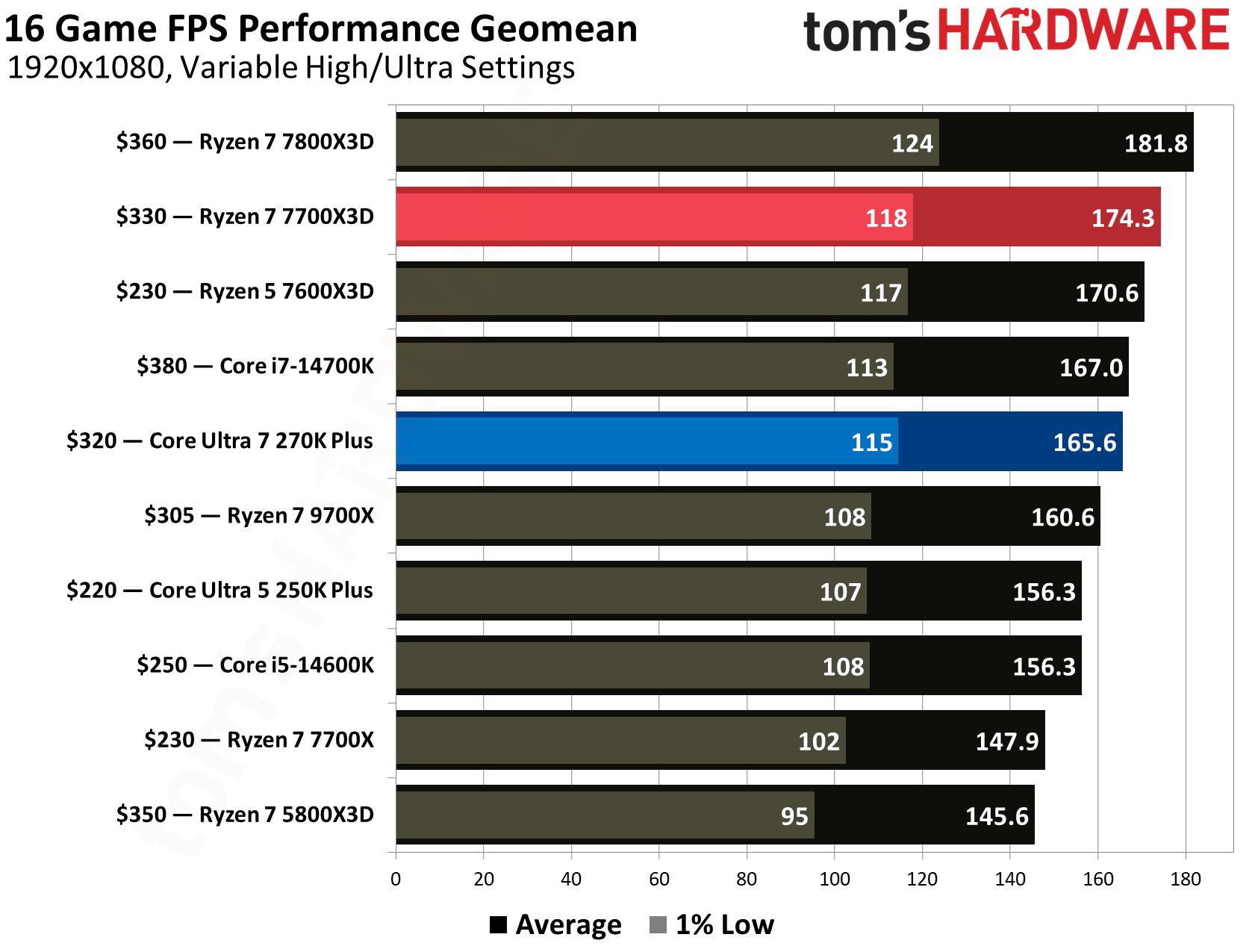
The 270K Plus vs 7700X3D decision is less about finding a universal CPU champion than deciding what the machine is meant to do. Tom’s Hardware positions Intel’s Core Ultra 7 270K Plus as the mixed-use option, with many more cores and higher official memory support, while AMD’s Ryzen 7 7700X3D is aimed at gaming-focused builders who also value AM5’s stated upgrade runway.
The listed prices are close enough that the surrounding parts can settle the purchase. Tom’s Hardware lists the Intel chip at a $320 street price, against a $300 MSRP, and the AMD chip at $330. Those are reported prices, not a retailer check, and motherboard, DDR5 kit, cooler and any existing components deserve a line on the spreadsheet before declaring either one a bargain.
Which CPU fits gaming and productivity better?
Intel’s Arrow Lake Refresh processor has 24 cores and 24 threads: eight performance cores and 16 efficiency cores. Its P-cores are rated for 3.7GHz base and 5.4GHz boost clocks; its E-cores run at 3.2GHz base and 4.7GHz boost. Tom’s Hardware lists 76MB of combined L2 and L3 cache and official support for DDR5-7200 memory.
AMD’s Zen 4 part takes the leaner route, with eight cores and 16 threads clocked at 4.0GHz base and up to 4.5GHz boost. It is listed with 104MB of total cache and DDR5-5200 support. Tom’s Hardware says 64MB of its L3 cache is vertically stacked, the 3D V-Cache design intended to reduce memory-latency bottlenecks in workloads that benefit from keeping more data close to the CPU.
Cache and computer memory are separate layers. Cache sits on or near the processor and holds frequently needed data; DDR5 RAM is the larger temporary workspace shared by running software. A higher memory-speed rating or larger cache specification does not, by itself, establish a performance result in a particular game or application.
Tom’s Hardware describes Intel as stronger in productivity work and AMD as gaming-oriented, but the supplied comparison does not include readable benchmark tables. Its gaming tests used 1080p resolution and an Nvidia GeForce RTX 5090 to reduce graphics-card limits. That setup is useful for exposing CPU differences, though it cannot predict the gap, if any, for every GPU or higher-resolution build.
Power, cooling and the motherboard question
The 270K Plus carries a 125W base power rating and can reach 250W maximum turbo power, according to Tom’s Hardware. The 7700X3D is rated at 120W; the publication’s specification table lists a 161W upper limit while its text says 162W PPT. That one-watt mismatch does not justify false precision, and neither rating is a measured consumption result. Builders should size cooling for the intended workload and motherboard power settings.
Platform life may be the sharper dividing line. Tom’s Hardware says the Intel chip uses LGA 1851 and expects its forward CPU-upgrade prospects to be limited as Nova Lake is anticipated later this year. AMD’s 7700X3D works with AM5 600- and 800-series boards, the publication says, and AMD has committed to support AM5 through at least 2029. Socket support is not a promise that every older board will run every future processor without a BIOS update or other constraints.
For a new mixed-use build, Intel’s substantially higher core count is the clear specification-level advantage. For a gaming-first build where a later CPU swap matters, AMD’s cache design and stated AM5 support horizon make the 7700X3D the more durable-looking route. Neither conclusion substitutes for same-settings testing in the games and applications a buyer actually uses.
This story draws on original reporting from Tom's Hardware.