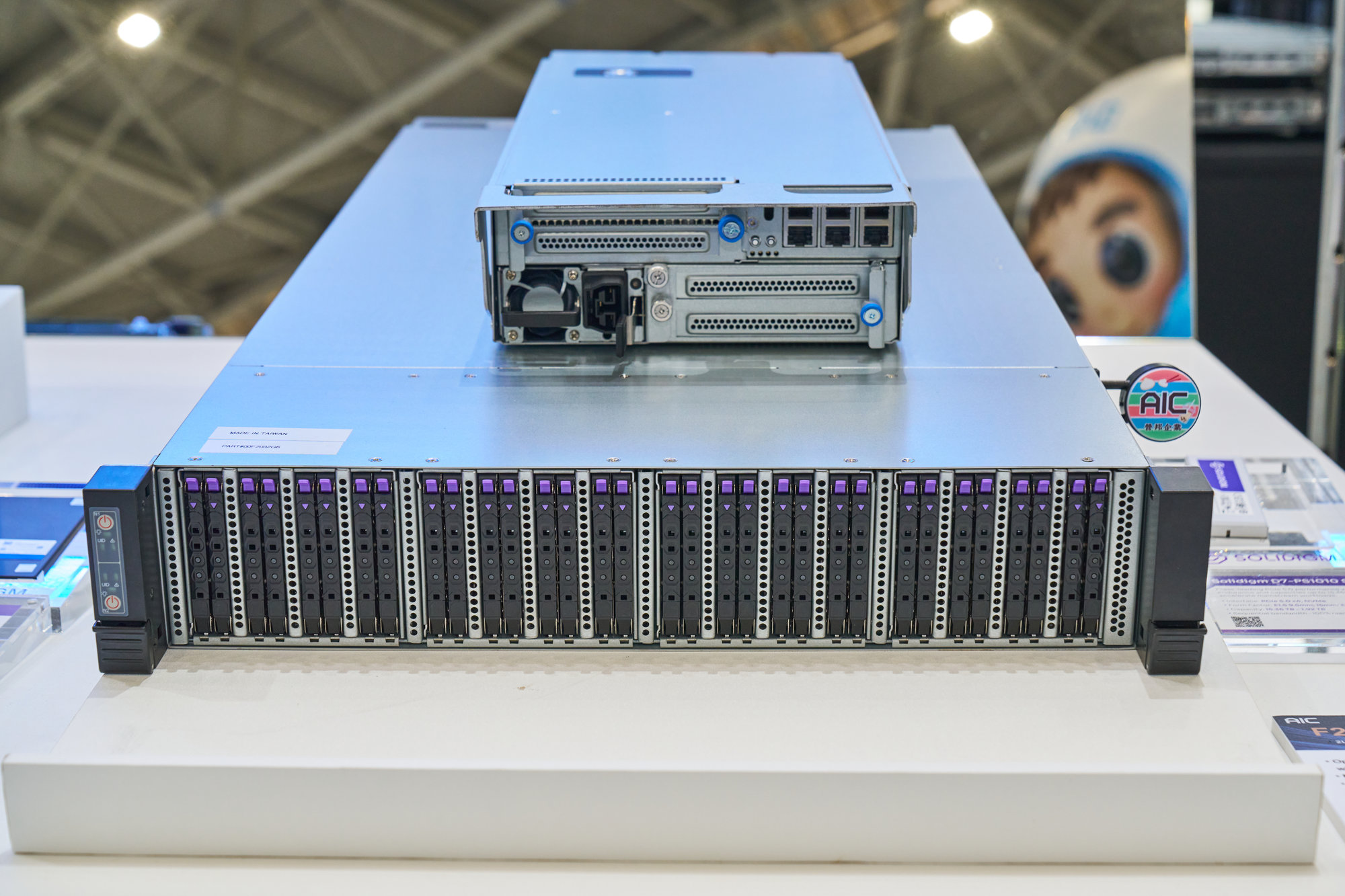
AIC used Computex to show the F2032-01-G6, a 2U just-a-bunch-of-flash storage server aimed at a problem AI operators can no longer wave away: fast, nearby storage for key-value cache data during inference.
ServeTheHome reported that the system, also referred to as the F2032-G6, holds up to 32 PCIe Gen6 E3 SSDs. With 256TB drives installed across all bays, the appliance would reach 8PB of raw flash capacity in 2U. That number depends on drive selection, of course, and the usual data-center caveats around endurance, cost and workload behavior still apply.
The box is AIC’s follow-up to its F2026-01-G5, a PCIe Gen5-era JBOF platform with 26 2.5-inch U.2 bays, according to ServeTheHome. The newer design moves to E3 drives and PCIe Gen6 across the storage fabric, a change that matters because the appliance is being positioned closer to Nvidia’s Context Memory Storage, or CMX, platform for Vera Rubin systems.
What is inside the 2U chassis
The front of the chassis is mostly drive real estate. ServeTheHome said AIC designed the system for 7.5mm E3 SSDs, supporting both long E3.L and short E3.S versions. The drives sit in hot-swappable trays, with narrow vents between pairs of bays to leave some airflow path through a very crowded front panel.
Inside, the storage fabric is built around Broadcom’s PEX90144, a 144-lane PCIe Gen6 switch, according to the report. AIC has not published a full architecture diagram for the system. ServeTheHome said that, based on the prior Gen5 model using Broadcom switching, AIC is likely giving each SSD two PCIe lanes to maximize the drive count. If that is how the final system is wired, PCIe Gen6 helps compensate for the bandwidth limits of a x2 link.
The rear is where the appliance gets more interesting than a passive shelf of SSDs. ServeTheHome reported that AIC built the server around two nodes, each with its own power supply and room for as many as two network expansion devices. Those slots can take NICs or DPUs, and the publication noted that a GPU is also possible.
BlueField-4 does the steering
AIC designed the JBOF to be controlled by at least one Nvidia BlueField-4 DPU, according to ServeTheHome. Those DPUs combine a Grace CPU with ConnectX-9 networking, support 800Gb Ethernet or InfiniBand, and use PCIe Gen6 for I/O. In this design, the DPU acts as the storage controller and gateway, deciding how hosts reach the SSDs behind the PCIe switch.
AIC is pitching the F2032-01-G6 as a high-availability system. The two-node design and support for multiple DPUs let the appliance keep operating if one controller path fails, according to the report. That redundancy is the part buyers will care about after the spec-sheet glamour wears off, because cache appliances that fall over during inference are just expensive ways to make GPUs wait.
The main target workload is Nvidia’s CMX key-value caching for Vera Rubin racks, ServeTheHome reported. In large inference clusters, key-value cache data lets systems reuse attention state instead of recomputing it. Keeping that data close to the GPUs can reduce bottlenecks, provided the storage and network fabric keep up.
AIC is also marketing the same platform for object storage, scale-out file systems and flash storage tiering, according to the report. Those are plausible fits for a dense PCIe 6 flash box, though the most specific design center here is clearly AI infrastructure tied to Nvidia’s next rack-scale systems.
This story draws on original reporting from ServeTheHome.