Asus is testing AI servers at rack scale in its Taiwan thermal labs, according to a ServeTheHome tour published after visits in April and June 2026. The work is aimed at a problem that data-center buyers now get to enjoy: a modern AI rack is no longer a pile of independent boxes with fans. It is a power-dense, liquid-cooled system where coolant flow, pressure drop, sensors and leak handling can decide whether the cluster behaves or becomes an expensive humidifier.
ServeTheHome disclosed that Asus sponsored the visit. That does not make the physics less real, but it does mean the tour shows the facilities Asus chose to show.
Full racks go into the chamber
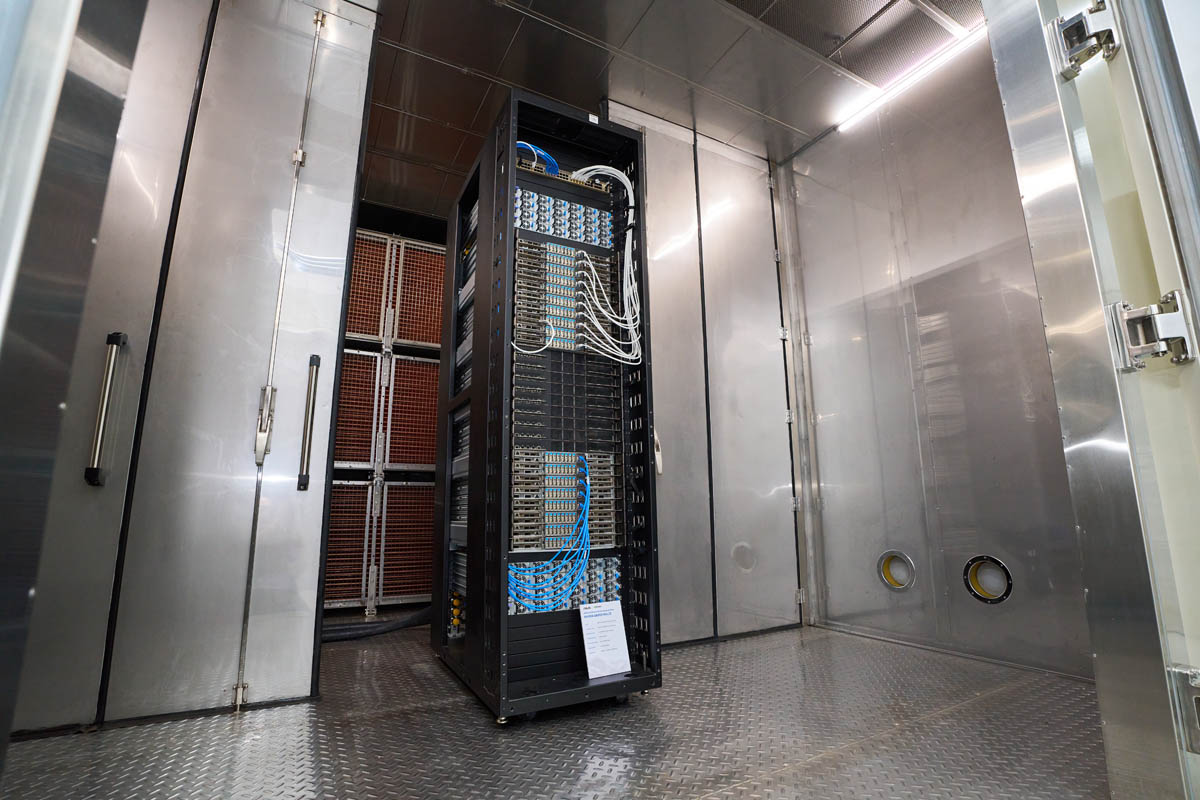
The first facility described is a walk-in environmental chamber for standard operating validation. ServeTheHome said Asus runs servers and full racks from 25 degrees Celsius to 45 degrees Celsius, a range meant to cover common data-center ambient conditions.
During the visit, Asus had an Nvidia HGX B200 eight-GPU Blackwell-generation server in the chamber, according to ServeTheHome. The chamber can take a full rack, which matters for liquid-cooled systems. A single tray test can show whether one server survives. A rack test shows whether coolant distribution, manifold behavior and node-to-node thermal interaction hold up when the system is assembled the way a customer will use it.
ServeTheHome said one current eight-GPU server node can draw power comparable to two older 208-volt, 30-amp racks. That is a tidy reminder that the AI boom did not repeal thermodynamics. It mostly concentrated the bill into fewer machines.
Asus also tests outside normal limits
A second, more aggressive environmental chamber accepts entire racks and can simulate temperatures from minus 40 degrees Celsius to 85 degrees Celsius, with humidity from 10 percent to 98 percent, according to ServeTheHome. The point is not that a data center should run at 85 degrees. The point is to expose shipping, storage and long-duration stress problems faster than waiting years for ordinary wear to do the job.
ServeTheHome reported seeing an Nvidia GB200 NVL72 rack in that chamber. The publication said full GB200 NVL72 and newer racks may ship by air or sea freight, and that many are moved in climate-controlled trucks. For assembled rack-scale systems, transport conditions are part of the reliability problem, not a logistics footnote.
Asus was running the rack liquid-cooling system at 20 degrees Celsius during the visit while also testing higher coolant temperatures, ServeTheHome said. Warmer coolant can reduce chiller energy use, but the tradeoff is less thermal margin and possible reliability impact. The only honest way to sort that out is measurement over long accelerated-aging runs, which is exactly what these chambers are for.
The lab is also a plumbing test
ServeTheHome also described an AI system research and development lab built around rack-scale liquid cooling. The space has overhead power distribution and coolant infrastructure under a raised floor. Beneath that floor is a piping network feeding racks through manifolds, with attention to pipe sizing, valve placement, leak detection and management software visibility.
The facility can handle up to 1.1 megawatts across its rack positions, according to ServeTheHome. At that density, air-cooled validation tells only part of the story. Asus has to test whether coolant reaches multiple cold plates correctly, whether sensors report reliably, and whether a leak can be detected and contained without taking down more of the cluster than necessary.
ServeTheHome said Asus uses the lab to validate systems such as Nvidia NVL72 racks before customer deployment, including installation and maintenance workflows. That is the less glamorous half of AI infrastructure: after the GPU keynote, someone still has to make the rack survive heat, humidity, shipping and a lot of water running near very expensive electronics.
This story draws on original reporting from ServeTheHome.