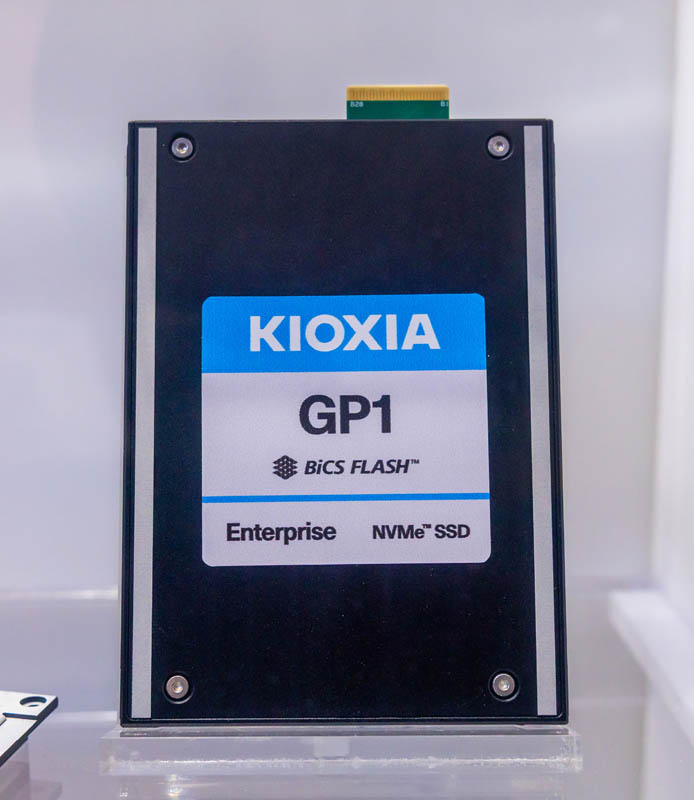
Kioxia brought its GP1 10 million IOPS claim to FMS 2026 in Santa Clara, showing a PCIe 6.0 NVMe SSD intended for AI systems that can access flash directly from GPUs. The headline number is narrow: Kioxia claims up to 10 million random-read IOPS using 512-byte accesses. It is not a general performance rating, and the company warns that read and write results vary with the host system, software and test conditions.
The GP1 was among the products Kioxia showcased at the Future of Memory and Storage conference, held August 4 through 6. On August 5, the company said its GP Series received FMS's Best of Show award in the Specialized Storage category.
What does Kioxia's 10 million IOPS claim measure?
Kioxia's disclosed figure measures random reads at a 512-byte block size. The company has not supplied a test configuration, queue depth, latency result, capacity or power figures alongside that claim in the materials reviewed here. Those omissions matter when judging a peak result intended for an AI-storage architecture rather than treating it as a catch-all SSD score.
The supplied materials also do not provide independently published benchmark methodology or results for a 10-million-IOPS run at the show. They establish that Kioxia announced and displayed the product, not an independently documented live benchmark.
How Kioxia wants GP1 to fit into AI servers
Kioxia positions GP1 as a persistent flash-storage layer that can extend the data available to AI workloads through GPU direct access. Its pitch is that systems working with larger datasets can use the drive alongside high-bandwidth memory, or HBM, rather than relying only on additional in-node HBM or DRAM.
That is a proposed system design, not proof of a universal remedy for AI infrastructure. GP1 remains SSD storage, which retains data when power is off; RAM is temporary working space for active programs. The distinction is worth keeping straight when vendors start describing storage as a memory tier. Memory and storage serve different jobs, even when a system attempts to make the boundary less painful.
Under the hood, Kioxia lists second-generation XL-FLASH low-latency flash, PCIe 6.0 and NVMe 2.2. The company says it designed the architecture to reach a future 100 million random-read IOPS, a target rather than a current product specification. Kioxia also calls GP1 the industry's first SSD optimized for GPU direct access, citing its own surveys, so that claim should be read as vendor research rather than an independent market finding.
When will Kioxia GP1 SSDs be available?
Not as a general product yet. Kioxia said it expects to offer evaluation samples to select customers by the end of 2026, and said those samples are intended for functional checks and may differ from mass-production drives.
The company lists E3.S and E1.S variants in 9.5 mm and 15 mm sizes, with cold-plate liquid-cooling support for E3.S and the 9.5 mm E1.S model. All listed formats support air cooling. Kioxia also lists endurance of up to 50 drive writes per day, another specification that will need scrutiny once production hardware and independent testing arrive.
This story draws on original reporting from ServeTheHome.