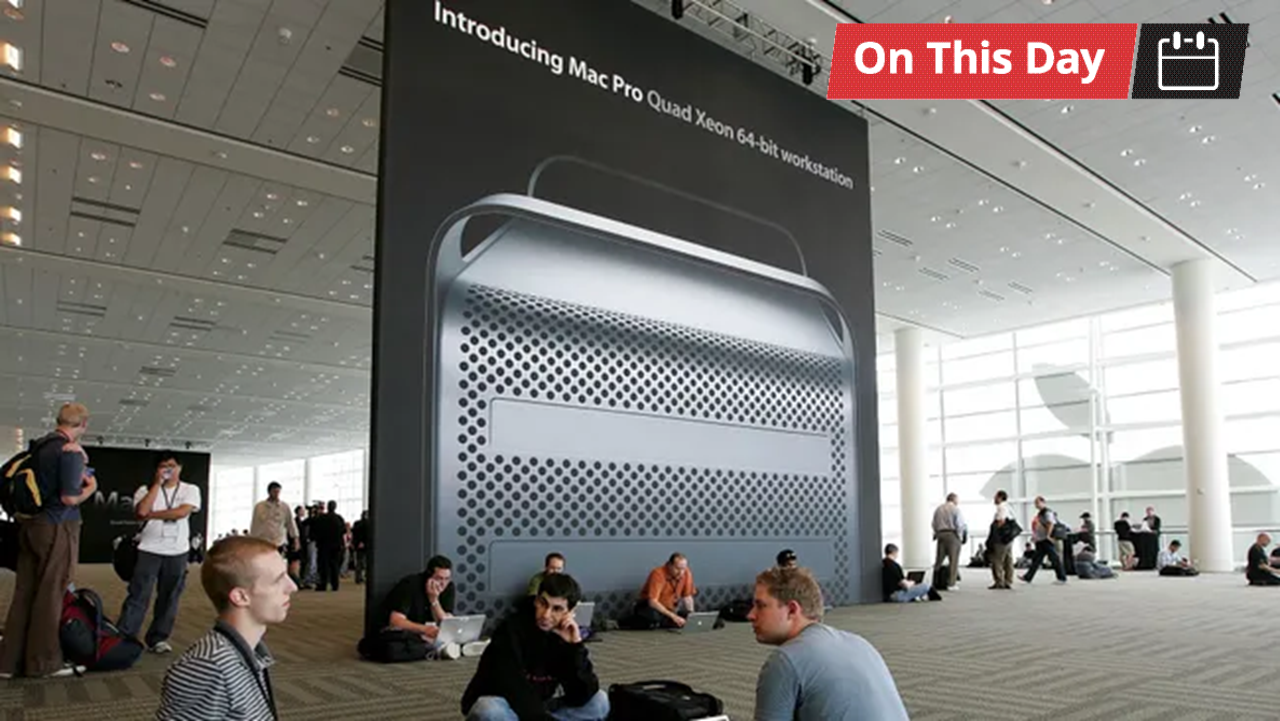
The original Mac Pro 2006 arrived in August 2006 as Apple’s replacement for the Power Mac G5, putting Intel Xeon processors in the company’s top desktop workstation while keeping the familiar aluminum tower. Two decades later, its importance is less about the perforated enclosure than the platform swap inside it: this was the last Mac Apple moved from PowerPC to Intel.
Steve Jobs introduced the machine at Apple’s Worldwide Developers Conference on August 7, 2006. Apple had already shipped Intel versions of the iMac, Mac mini and MacBook earlier that year. With the Mac Pro, the company said it had completed the broader processor transition in seven months, or 210 days. That is Apple’s claim, not an independently measured milestone, but the hardware change was real and consequential for its professional desktop line.
Why was the original Mac Pro important?
The Mac Pro took over from the Power Mac G5, which used PowerPC chips, and shifted Apple’s workstation to Intel’s x86 architecture. The first model used two dual-core Intel Xeon processors, with the highest-end configuration clocked at up to 3.0GHz. Apple advertised performance of up to twice that of the Power Mac G5 Quad, a company comparison rather than a general benchmark verdict.
Externally, Apple did not try to disguise the handoff. The original Mac Pro closely resembled its predecessor’s aluminum tower. Internally it offered the kind of expansion expected of a workstation, including four PCI Express 1.0 slots, one double-width slot for graphics, and four drive bays.
What hardware did Apple include in the 2006 Mac Pro?
The base specification included 1GB of DDR2-667 fully buffered RAM, expandable to 16GB, a 250GB hard drive, and Nvidia GeForce 7300 GT graphics with 256MB of GDDR3 memory. Storage could reach 2TB across the four bays. RAM and storage do different jobs: RAM is temporary workspace while software runs, while the hard drive keeps files after shutdown. Apple’s figures therefore described two separate limits, not interchangeable capacity.
- Two dual-core Intel Xeon processors
- Four PCIe expansion slots
- Two Gigabit Ethernet ports
- USB 2.0 plus FireWire 400 and FireWire 800 connections
- A 16x optical drive, with space for a second
Apple sold a configuration with two 2.66GHz Xeon 5150 chips and the base hardware for $2,499 in the United States, including an Apple keyboard and Mighty Mouse, according to Tom’s Hardware. Configurable memory, graphics and storage meant buyers could spend more, as workstation buyers reliably do.
The line’s ending makes the anniversary unusually neat. Apple brought Apple silicon to the Mac Pro with an M2 Ultra model in June 2023, according to MacRumors. Apple then announced in March 2026 that it had discontinued the Mac Pro, with no further models planned. The product that finished Apple’s first major processor migration ended shortly after completing its next one.
This story draws on original reporting from Tom's Hardware.