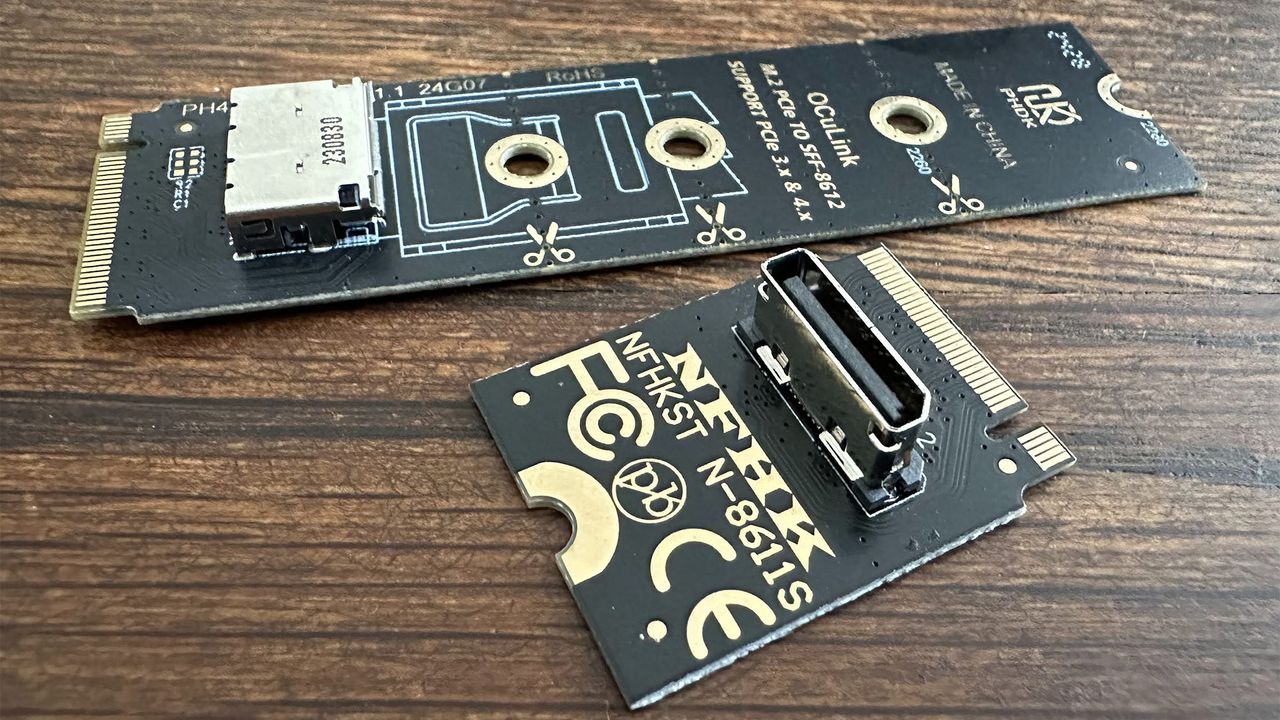
A Reddit user says they built a Steam Machine RX 9070 XT eGPU setup by sacrificing the compact PC's lone internal M.2 storage slot for an external graphics connection. The reported result is an AMD Radeon RX 9070 XT driving Crimson Desert at more than 100 frames per second on the High preset. It is a clever hardware hack, not a tidy upgrade path.
Tom's Hardware identified the modder as Large_Customer_3840. Their build puts an M.2-to-OCuLink adapter in the Valve Steam Machine's sole M.2 PCIe 4.0 NVMe slot, then runs an OCuLink cable to an Aoostar EG01 eGPU dock carrying the desktop RX 9070 XT.
That arrangement repurposes the connection ordinarily used by the system SSD. The modder therefore moved the boot drive into a USB-C-to-NVMe enclosure and booted from the Steam Machine's rear USB 3.2 Gen 2, 10 Gbps USB-C port, according to Tom's Hardware. An SSD is persistent storage rather than system memory, a distinction that matters when an internal drive is displaced for a PCIe device. Read more about how memory differs from storage.
How does the Steam Machine RX 9070 XT eGPU mod work?
OCuLink carries PCIe connectivity outside a computer, allowing the M.2 slot to talk to an external dock rather than an SSD. In this case, the EG01 supplies the PCIe slot and supporting electronics for the graphics card. The dock used here has no enclosure and no integrated power supply, Tom's Hardware reported, so the build also leaves a desktop GPU and separate PC power supply out in the open.
The physical arrangement is unfinished, too. The cable needs a route through the rear of the Steam Machine chassis. The user had not yet modified the case and was operating the system open, according to the report. That is the sort of detail usually absent from “external GPU” photos until the cable has to go somewhere.
The modder said the RX 9070 XT became the primary display adapter at startup without manually choosing a graphics adapter. Tom's Hardware reported the over-100-FPS Crimson Desert result at High settings. GameGPU separately described the test as 1440p at High, but that resolution and the wider test configuration have not been independently documented in the available reporting.
There are no frame-time results, test-scene details, upscaling settings or repeatable benchmark procedure in the reports. The result therefore establishes that this individual setup ran the game and produced the claimed reading, not that every Steam Machine can expect the same behavior or performance.
What does the modification cost the Steam Machine?
It trades the internal SSD connection for the graphics link, moves the operating system to USB-C storage, requires external graphics hardware and power, and currently leaves the machine with an open-case cable arrangement. For tinkerers, that is the point. For anyone expecting a console-like box, it is a fair warning.
This story draws on original reporting from Tom's Hardware.