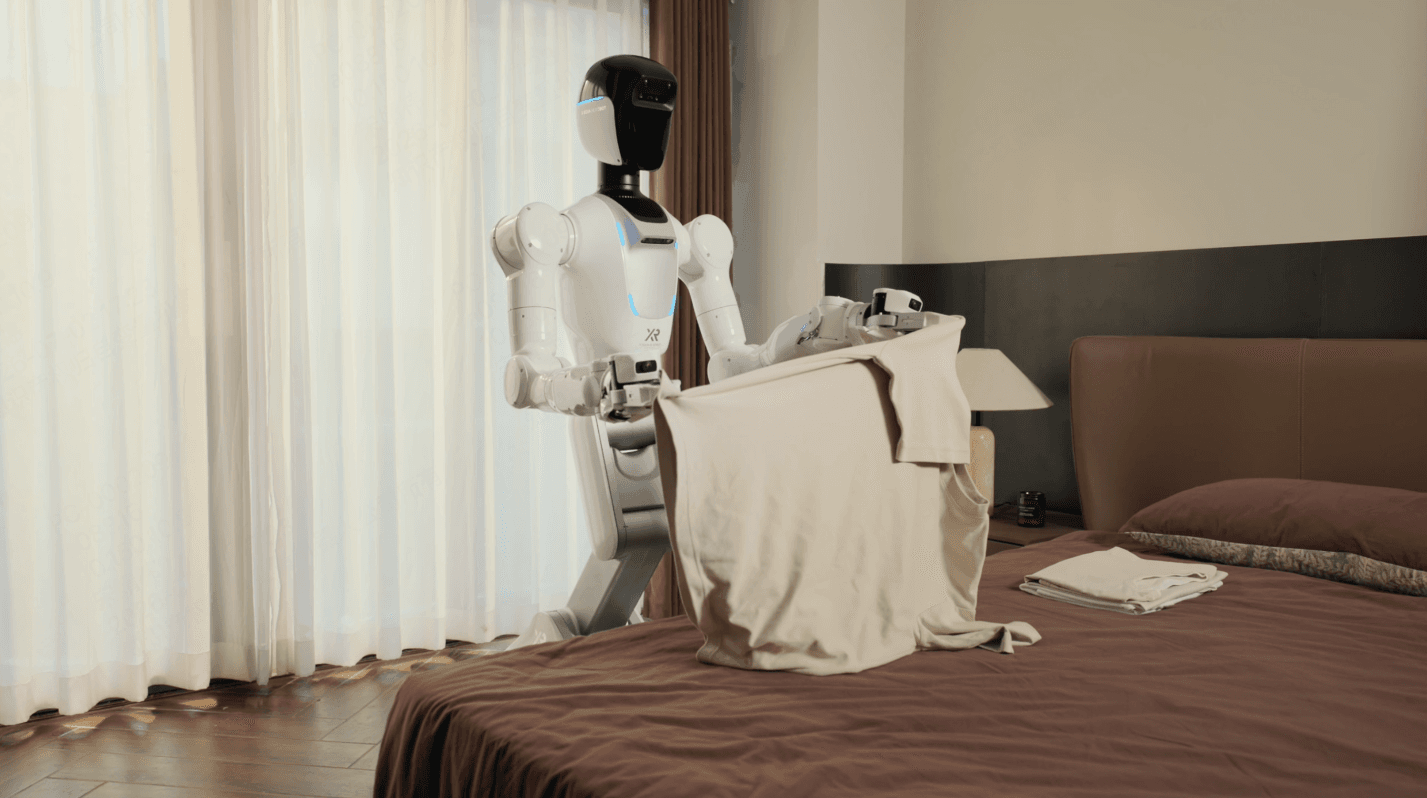
X Square Robot is arguing that general-purpose robots need something closer to a foundation-model stack than the usual pile of perception, planning and control modules. The Chinese embodied-AI company says its approach ties together training data, a predictive world model and an action model, with parts of the system released openly for researchers to test.
The claim is ambitious, and most of the evidence still comes from X Square Robot’s own robots, datasets and benchmarks. That caveat matters. Robotics has a long history of demos that look tidy until they meet a different gripper, a different kitchen or a mildly uncooperative towel.
The stack X Square Robot is proposing
X Square Robot describes its system as three linked layers inside a broader World Unified Model direction: data collection, a world model called WALL-WM and a vision-language-action model called Wall-OSS-0.5. The company says the components share infrastructure while remaining complementary model families.
The main design choice is to treat robot learning as interaction with the physical world, rather than as a sequence of joint motions. A demonstration counts only if it produces the intended change, according to the company’s description. That sounds obvious until a dataset labels a failed grasp as a grasp because the fingers moved in the right-looking way.
Data collection with a replay test
X Square Robot says its QUANXTA Zero Series data system collects demonstrations from people wearing a rig with dual grippers, instead of having operators teleoperate a robot for every example. The company says this makes collection cheaper and more diverse, because the person records manipulation behavior before it is mapped onto a particular machine.
The more interesting bit is quality control. X Square Robot says it runs automated inspection, kinematic checks and physical playback on real robots. Only trajectories that actually complete the task are counted as valid. The company reports roughly an 85 percent data-validity rate for the pipeline, and says pretraining on robot-free demonstrations plus a smaller amount of real-robot data can reach performance comparable to an all-robot dataset at about one-twentieth the collection cost.
That cost comparison is X Square Robot’s claim, and the strongest reported results remain tied to its own collection system and robots.
A world model built around events
WALL-WM is X Square Robot’s attempt to model robot behavior around physical events such as reaching, grasping and placing. Many robot action systems generate fixed-length chunks of motion from an image and instruction. X Square Robot says fixed windows can split one action or merge separate actions, which makes long tasks harder to represent.
The company says WALL-WM couples a text-to-video model with a newly initialized action network that reads video features without overwriting them. It then supports two modes: variable-length event mode for longer-horizon reasoning, and fixed-length chunk mode for real-time robot control.
X Square Robot reports that WALL-WM performed well on long-horizon tasks in unseen settings and beat fine-tuned baselines on its own real-robot benchmark. The public release of the code should make those claims easier for outside researchers to reproduce or puncture.
An action model meant to run before fine-tuning
The action layer, Wall-OSS-0.5, sets a stricter bar than many robot models: X Square Robot says the pretrained model should work on a real robot before task-specific fine-tuning. The company says the model trains discrete action tokens, language grounding and continuous action generation together, while keeping gradients active through the system.
X Square Robot also describes an action interface called X-Tokenizer. Instead of turning motion into opaque codes, the company says X-Tokenizer learns a hierarchy in which higher-level codes represent motion intent and lower-level codes capture detail, aligned with language-model features. X Square Robot says this improves stability and helps reuse the tokenizer across robots without retuning.
The company’s valuation has risen above 20 billion yuan, about $2.9 billion, according to X Square Robot. Investors appear to be paying for the same bet the company is making technically: that data infrastructure, world models and pretraining systems will matter more than isolated robot demos. The next test is whether the stack survives contact with labs and robots X Square Robot does not control.
This story draws on original reporting from IEEE Spectrum.