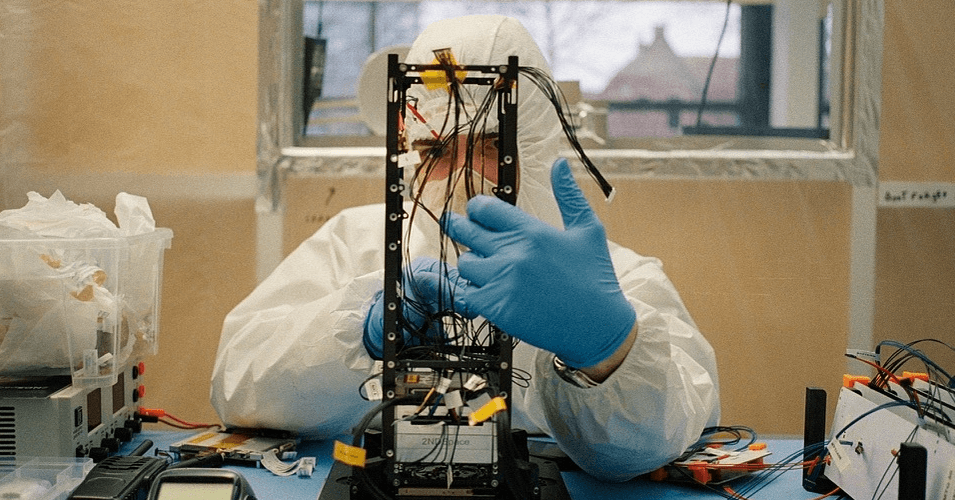
British startup Mass Balance has put a small autonomous chemistry platform into orbit, starting with a modest test: prove the machine can run an experiment and send back usable data without anyone touching it. If that works, the company wants to use microgravity to study disease-linked proteins that are awkward to observe on Earth.
The apparatus, described by WIRED as roughly grapefruit-sized, launched Tuesday morning on a SpaceX transporter mission. It sits inside a 10-centimeter pod made by Austrian company Tumbleweed. The package carries chemicals, sensors and control hardware intended to keep the experiment running while it circles Earth for a couple of months.
During the flight, Mass Balance plans for the system to monitor how live cells grow, react and function in weak gravity, then transmit measurements back to the ground. That is the sales pitch for orbital biotech in miniature: put the annoying parts of wet lab handling into a box, launch the box, and hope the data are cleaner than what gravity-soaked Earth can provide.
Why gravity gets in the way
Mass Balance co-founder and chief executive Toby Call told WIRED that removing gravity can create useful conditions for life sciences and pharmaceutical research. His longer-term goal, he said, is to make space a routine research setting rather than a bespoke stunt with a launch manifest.
The technical argument is straightforward. On Earth, gravity helps drive convection, where heat moves through a fluid, and sedimentation, where denser material settles. Those effects can interfere with measurements in chemical and biological systems. In microgravity, researchers may be able to watch some processes with less of that background noise.
Call is especially interested in intrinsically disordered proteins, a class of proteins associated with age-related diseases such as Alzheimer’s disease, Parkinson’s disease and some cancers, according to WIRED. These proteins do not hold one stable shape. They shift around, which makes them hard to image and hard to represent in the datasets used to train life sciences models.
WIRED reported that this creates a data gap for tools such as Google’s AlphaFold, limiting their ability to predict how these proteins behave and how they might respond to drugs. Some scientists believe microgravity could make certain disease-driving disordered proteins easier to study, according to research cited by WIRED.
The first flight is a systems test
Mass Balance is not sending its target protein program up on this first mission. The company is testing its operating system and data capture pipeline. The payload contains an industrial biocatalyst that will break down another chemical compound. The platform will use light-based monitoring to check whether the reaction proceeds as intended.
If the system works, Call plans to run microgravity experiments on disordered proteins and use those results to train an AI model adapter. WIRED reported that Mass Balance expects revenue from the model, data licensing and access to the data itself. That remains a plan, not a proven business.
Mass Balance is part of a small cluster of companies trying to turn orbit into lab infrastructure. British firm BioOrbit launched a test unit in May aimed at growing ultra-pure, stable crystals for injectable cancer drugs. Varda Space Industries, an American-owned company, is also working on pharmaceutical processing in microgravity.
Mass Balance is taking a different engineering route. Unlike BioOrbit and Varda, WIRED reported, it does not plan to recover the platform intact. Skipping reentry avoids the problem of building hardware that can survive the heat and mechanical stress of returning through the atmosphere. It also means the company’s near-term product is data, not a capsule full of returned material.
This story draws on original reporting from WIRED.


