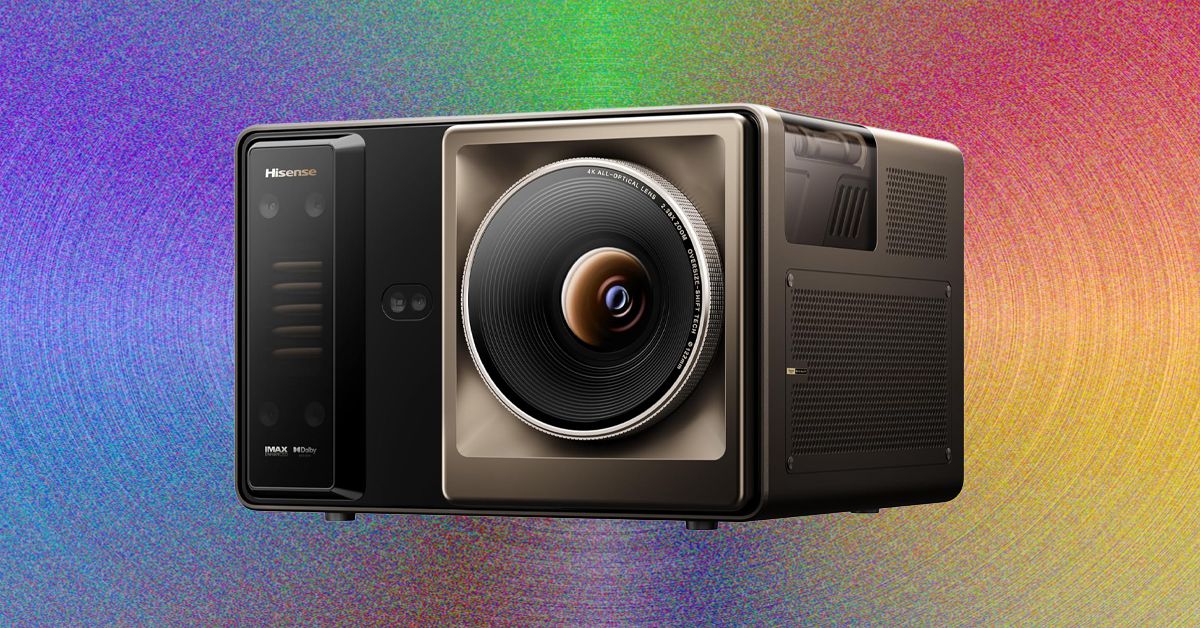
Hisense’s XR10 smart projector delivers the color show its $6,000 price implies, according to a new Wired review by John Brandon, though buyers hoping to use it like a living-room TV with the shades open should calm down.
Wired rated the XR10 8/10. Brandon described it as a high-end home cinema projector with vivid color, strong gaming performance, quick setup, and useful manual light control. He also found weaknesses: middling bright-room performance, limited voice control, some tonal issues, and HDMI eARC problems with his test receiver.
The XR10 is built around RGB lighting, the same broad direction now showing up in premium televisions to expand color and brightness. Hisense rates the projector at 6,000 lumens with a 6,000:1 native contrast ratio. The unit also includes an adjustable iris, which changes how much light passes through the optical system. That matters most in dark scenes, where too much light can flatten black levels into gray sludge.
Brandon found the hardware substantial in the most literal sense. The XR10 weighs 23.4 pounds, heavier than the 18-pound Xgimi Titan Noir Max he used as a comparison point. He liked the dark metallic cube design and the four adjustable feet, which allow finer height and angle corrections than projectors with only front feet.
Setup, software, and ports
According to Wired, setup took about 10 minutes, including app installation, keystone correction, and focus. The projector can map its image to the screen automatically, though Brandon said it still needed some manual adjustment.
The XR10 runs Hisense’s VIDAA operating system, rather than Google TV or another more common streaming platform. Brandon said the interface was familiar from the Leica Cine Play 1 and mostly workable, though Fandango at Home was missing from the app lineup he wanted.
The port selection is decent with caveats. The XR10 has three HDMI ports, but Wired reported that only two support HDMI 2.1. The middle HDMI port handles eARC audio passthrough. Brandon said he saw dropped audio, black flashes, and other glitches when using that eARC port with an Onkyo TX-RZ50 AV receiver. Wired said Hisense is investigating the issue.
Other connections include Ethernet, two USB ports, optical digital audio, and a 3.5-mm jack. Wi-Fi 7 support is also included. Brandon said the liquid-cooled projector stayed mostly quiet during testing, despite having a fan, and he found the built-in speaker unusually clear and loud for a projector.
Color was the main event
Wired’s testing found the XR10 reached 118 percent of the BT.2020 color gamut, ahead of the Titan Noir Max’s reported 110 percent. Brandon said films such as Inside Out and Guardians of the Galaxy Vol. 2 showed the XR10’s color strength, especially in purples, reds, and yellows.
The XR10’s iris is manual, with seven levels, while the Titan Noir Max adjusts dynamically during viewing. Brandon preferred the Titan’s dynamic iris in some cases, but said the Hisense controls helped with dark scenes when he dug through the menus.
On test material from Spears & Munsil, Wired found a more mixed result. Brandon said skin tone handling was good, though it did not match LG’s Micro RGB TV or the Titan Noir Max. He also saw slight blur in a white mist and mountain sequence, and less realistic rendering in some yellow flower and dark tree scenes.
Bright rooms were the XR10’s clearest practical limit. Brandon reported that several films looked too dim even with brightness raised, and episodes of Blue Lights on Britbox appeared washed out and gray at times.
Gaming fared better
Wired found the XR10 persuasive for games. On an Xbox Series X, Brandon said Senua’s Saga: Hellblade II showed convincing contrast on water and rocks. In Forza Horizon on Xbox and PC, he said nighttime winter races looked sharp and realistic. The projector supports 240-Hz refresh at 1080p and automatically switches into a low-latency gaming mode.
Voice control was less convincing. Brandon said the projector could change some settings by voice, but a request to increase brightness produced movie suggestions instead. Searches could also return descriptions rather than useful app results.
Wired’s bottom line: the Hisense XR10 belongs near the top of the home cinema projector market, especially for dark-room movie watching and gaming. The caveats are the familiar expensive-projector ones, plus a few Hisense-specific annoyances: keep the room dark, do not expect elegant voice control, and test the eARC chain before declaring the home theater finished.
This story draws on original reporting from WIRED.


