The PRIMA implant macular degeneration results now include a three-year update: researchers reported in October that some patients with advanced dry age-related macular degeneration retained device-assisted improvements in central vision. The update, presented at the American Academy of Ophthalmology meeting, is encouraging but not a cure for the disease, and it has not yet appeared as a new peer-reviewed study.
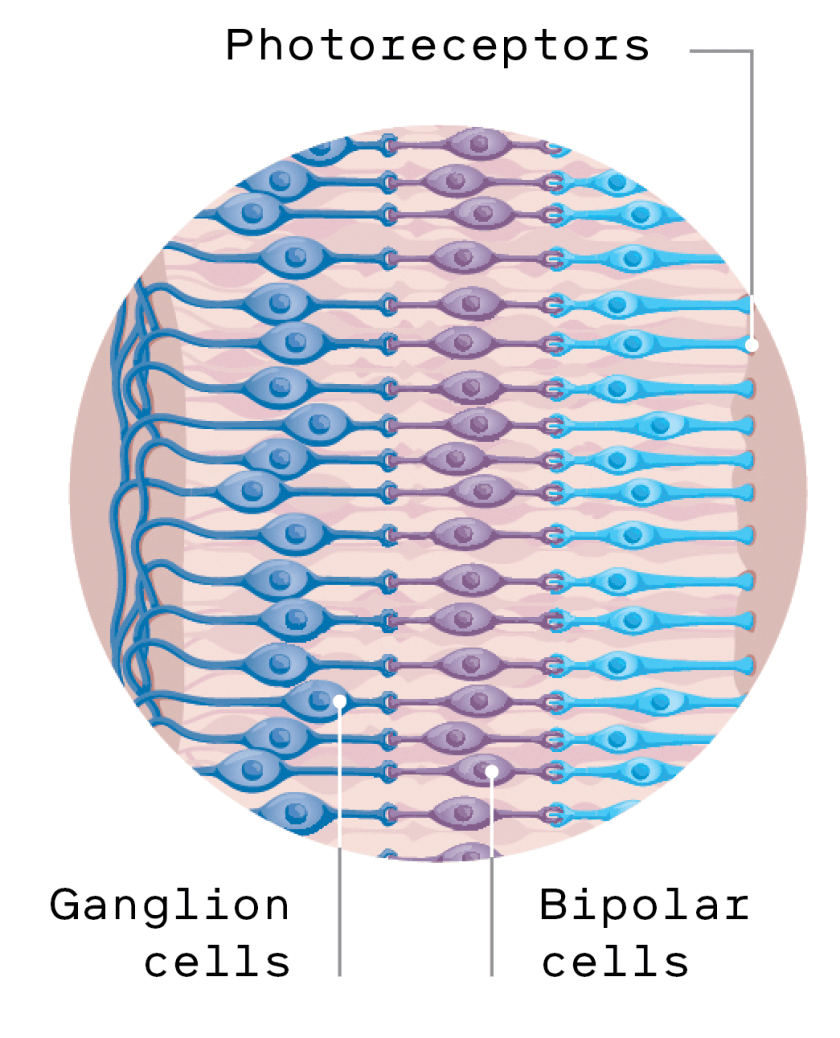
PRIMA is made by California-based Science Corporation and is designed for geographic atrophy, an advanced atrophic form of dry AMD. In this condition, photoreceptors in the central retina die, leaving people with a central blind spot while some of the retinal circuitry behind those cells remains intact. The device is meant for people who have lost those photoreceptors but retain functioning inner retinal cells, according to the University of Pittsburgh and BrightFocus Foundation.
How does the PRIMA implant work for macular degeneration?
A surgeon places a wireless 2-by-2-millimeter chip beneath the retina, where the lost light-sensing cells once worked. The patient then uses glasses with a forward-facing camera and an infrared projector. The camera captures the view; an external processor converts that feed; and the glasses project near-infrared light onto the chip.
The implant’s 378 pixels convert that light into electrical current, stimulating surviving retinal cells that relay visual information toward the brain. Its photovoltaic cells also power the chip, so there is no implanted battery, MIT Technology Review reported. It is a prosthetic visual system, not a biological repair for AMD.
What did the trial find?
The PRIMAvera trial enrolled 38 people aged 60 and older across 17 centers in five European countries. In results published in 2025, 32 participants completed a year of follow-up. Twenty-six had clinically meaningful gains in visual acuity, while 27 said they used the system at home to read numbers or words. Average improvement was 25 letters, about five lines on a standard eye chart, and 81% gained at least 10 letters, according to the University of Pittsburgh.
At three years, the American Academy of Ophthalmology reported efficacy data for 18 participants. Average device-assisted acuity was about 20/120, compared with roughly 20/460 at the start of the trial. Fourteen of the 18 improved by at least two eye-chart lines, and the same number improved by at least three.
Those figures need their denominators attached. The study had no control group, and only 18 of the original 38 participants were assessed for efficacy at 36 months. The academy’s summary did not say why the other participants were not assessed, leaving room for attrition bias. It also reported that most serious complications occurred in the first year; three patients had one serious eye-related adverse event each between months 13 and 36.
Who can get PRIMA, and what can it restore?
Recipients need rehabilitation to learn to use the signals alongside their remaining vision. Reported functions include reading letters, numbers, and words. Trial investigator José-Alain Sahel said the implant alone is not expected to restore 20/20 vision, and BrightFocus reported that its visual field is unlikely to be broad enough for driving.
PRIMA received a CE mark in July 2026 and can be sold in Europe. It had not received FDA authorization in the United States in the supplied reporting. The system is not established for wet AMD, according to BrightFocus.
This story draws on original reporting from MIT Technology Review.