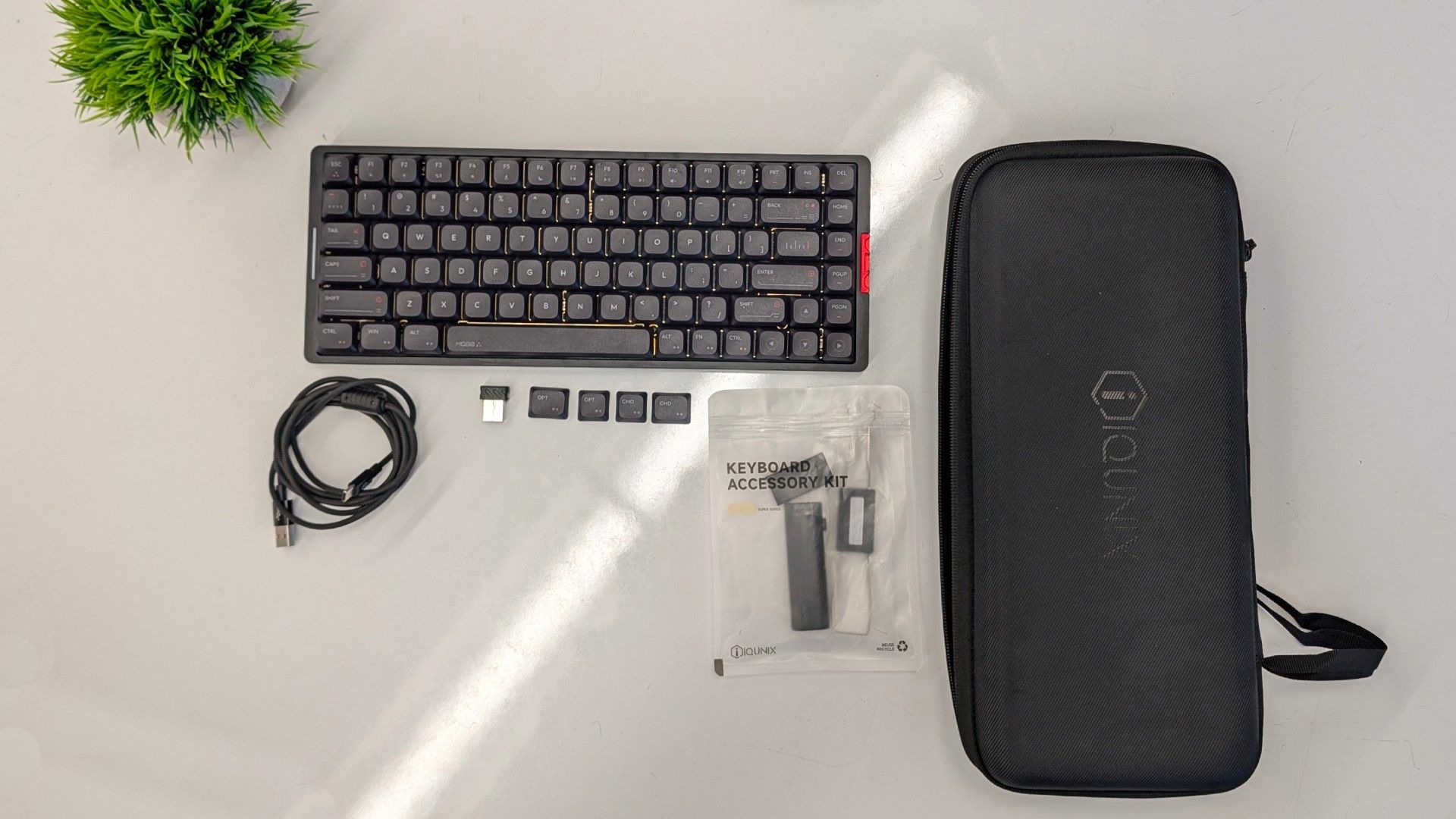
This IQUNIX MQ80 review lands on an inconvenient but useful conclusion: IQUNIX built a low-profile mechanical keyboard that makes the most sense parked on a desk. Its short front edge, compact layout and aluminum construction target people who want laptop-like height without giving up mechanical switches, wireless modes or key remapping. At 2.6 pounds, though, it is not the featherweight bag companion its outline suggests.
Tom’s Hardware lists the MQ80’s release date as February 25, 2025, with a $159.99 MSRP. IQUNIX’s product page showed a $159 regular price when captured, although availability and retail pricing can change. The manufacturer had marked the model sold out at that time.
Is the IQUNIX MQ80 good for travel?
Only if slimness matters more than weight. The MQ80 measures 0.41 inches at its front edge and up to 1.08 inches at the rear, according to Tom’s Hardware, but its CNC-machined aluminum enclosure brings the total to 1,180 grams. IQUNIX includes a hard-shell carrying case, yet Tom’s Hardware concluded that most buyers would not want to haul that weight every day.
The layout is a compressed 75%-style design: it retains a function row, arrow cluster and navigation/editing keys while removing the usual gaps between sections. The supplied reviews disagree on the exact key count, with Tom’s Hardware listing 80 and SemiPro Tech+Gear listing 84, so the more useful description is compact TKL-like rather than a numerically precise label.
What hardware and connections does it offer?
The keyboard has PBT keycaps, per-key RGB lighting, a 4,000mAh battery and USB, 2.4GHz wireless and Bluetooth 5.1 connectivity, according to Tom’s Hardware. It uses Kailh low-profile linear switches with 40g actuation force, 1.2mm pre-travel and 2.8mm total travel. Sources vary on the switch’s marketing name, calling it Rose Red or Gold Red, but agree on those basic characteristics.
That light actuation is part of the trade-off. Tom’s Hardware found the switches sensitive enough to reward a lighter touch, while it praised the keyboard’s sound among low-profile models. SemiPro Tech+Gear also reported a solid build and stable Bluetooth and 2.4GHz connections during testing up to three feet away. Its review unit came from IQUNIX and the video includes affiliate links, disclosures worth keeping in view.
Bluetooth evidence is mixed rather than settled. A later Mercury News review, published in July 2026, reported occasional extra spaces and glitches over Bluetooth, while favoring wired USB-C or the 2.4GHz dongle for the 1,000Hz polling rate. That does not establish a universal fault, but it makes the dongle or cable the less contentious option for latency-sensitive use.
What can buyers customize?
The MQ80 works with VIA for key remapping, macro creation and lighting controls, with four layers or profiles reported by Tom’s Hardware and SemiPro Tech+Gear. There are separate Mac and Windows modes. IQUNIX also says its custom firmware does not support Mod-Tap, Layer-Tap, KC_MEH or KC_HYPR modifiers, a limit that matters to people expecting the whole QMK-style bag of tricks.
IQUNIX claims as much as 350 hours of battery life over Bluetooth with lighting turned off. That is a best-case manufacturer figure, not a promise for RGB use. Tom’s Hardware’s reviewer reported nearly two weeks between charges with lighting enabled, a more practical but still individual test result.
For $159 or thereabouts, the MQ80’s case, low typing height, wired and wireless options, and VIA support make a coherent premium desk keyboard. Buyers shopping for a genuinely lightweight travel board should not confuse low profile with low mass. Physics remains undefeated.
This story draws on original reporting from Tom's Hardware.