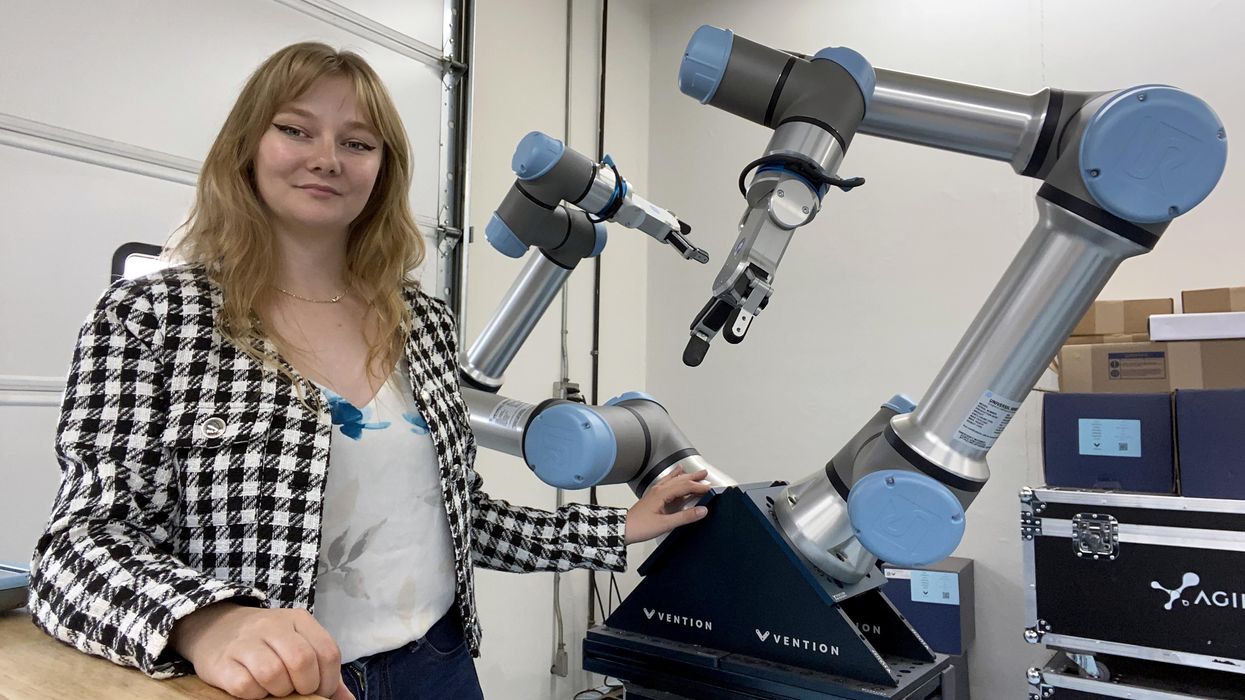
Sarah Downs is working on a problem space hardware engineers do not get to hand-wave away: how a robot arm can put a part into the right hole when the work site is orbit, the target is moving, and a camera may be useless or late.
Downs, an IEEE graduate student member and electrical engineering Ph.D. student at Texas A&M University, developed an algorithm for a robot assembling satellites in space, according to IEEE Spectrum. The work, done for her final project as a master’s student at the University of Tulsa, was carried out in collaboration with NASA and the U.S. Air Force.
The task sounds small because humans are good at it. Engineers call it peg-in-hole insertion: fit one object into its matching opening. In Downs’s project, the object is an antenna that must be guided into the correct location on a satellite and held there while adhesion takes place.
A robot that feels instead of sees
Satellite assembly robots often use cameras to align parts. Downs’s system does not. She told IEEE Spectrum that cameras in space can fail or introduce delays, which is a polite way of saying that a vision stack is only useful when it still has eyes and timely data.
Her approach uses force feedback. The robot loosely holds the antenna, then uses a torque sensor on its gripper to infer how the antenna and satellite sit relative to each other. The arm uses that force information to guide the antenna into the target opening.
The zero-gravity setting adds the nasty part. Downs told IEEE Spectrum that without gravity, the arm’s reaction torques can shove the satellite rather than just the part. Push too hard in one direction and the satellite can keep drifting that way. Downs is calculating targeted reverse thrusts to counter the forces created by the arm during insertion.
Downs is now continuing satellite assembly and manipulation research at Texas A&M’s Robotics and Automation Design Lab, or RAD Lab, through its Robotic Space Simulator project. The lab, which works with NASA, focuses on machines for extreme environments. Her adviser is Robert Ambrose, a NASA veteran who founded the RAD Lab in 2022 and is set to become associate director of Texas A&M’s Space Institute in Houston, according to IEEE Spectrum.
From Tulsa robotics clubs to space assembly
Downs grew up near Tulsa, Oklahoma, and told IEEE Spectrum she became interested in robotics through her middle school First Lego League team. PBS specials on NASA’s Spirit and Opportunity Mars rovers, plus the 2011 launch broadcast for Curiosity, helped point her toward NASA work.
Her route was not a straight line drawn by a college brochure. Her father, a safety adviser in the oil and gas industry, died of a heart attack in 2015 when Downs was 13. Her mother later returned to college for a business degree to support the family. Downs told IEEE Spectrum that the experience made financial stability a factor in how she thought about engineering.
She studied electrical engineering at the University of Tulsa after graduating high school in 2020. As an undergraduate, she worked with two classmates on a lunar lander exhibit for the Tulsa Air and Space Museum. The interactive display lets visitors use a controller to explore simulated surfaces of the moon, Venus, Mars, and Titan, and IEEE Spectrum reported that it remains on display.
Before the NASA-funded work began, Downs spent time at the University of Tulsa’s Institute for Robotics and Autonomy. There, she developed a robotic arm intended to help older people and wheelchair users at home by identifying objects and placing them where they belonged, such as sorting groceries from a bag onto a shelf or into containers.
Downs also led the University of Tulsa IEEE student branch from 2022 to 2024. IEEE Spectrum reported that the group expanded from a few events to one about every two weeks, and that its executive board grew from about five students to 25 in 2023.
After her Ph.D., Downs told IEEE Spectrum she hopes to work for NASA on Mars sample-collecting rovers or robotic arms for space stations. For now, the work is more prosaic and more difficult: making a machine do a careful assembly task when the usual assumptions about weight, vision, and a stable workbench do not apply.
This story draws on original reporting from IEEE Spectrum.